What if the heartbreak of a failed IVF cycle wasn’t just an end point, but the most precise diagnostic tool your clinical team has ever had? It’s natural to feel as though your body has let you down, particularly as you process the physiological hormone crash that often leaves you feeling depleted. Integrating functional medicine after failed IVF allows us to look deeper into your systemic health, addressing the root causes of cycle outcomes while supporting your emotional well-being. You might be struggling with the heavy anxiety that you’re losing time, but this period of recovery is actually your most valuable opportunity for optimization.
This article provides a clear, clinical plan to help you regulate your nervous system and improve egg quality through advanced diagnostics and systemic recovery. We will examine how specialized modalities, such as laser therapy and targeted peptide support, can optimize your uterine environment and cellular health. Since cumulative live birth rates can reach 85% to 90% after three cycles for those under 40, you’ll learn how to transform this difficult pause into a period of intentional preparation. Discover how advanced tools like Genova diagnostics and ozone therapy can pave a more resilient path toward your future success.
Key Takeaways
- Understand the physiological mechanisms behind the post-IVF hormone crash to better manage your physical recovery and emotional well-being.
- Learn how clinical acupuncture and laser therapy (LLLT) work synergistically to enhance pelvic blood flow and boost mitochondrial energy within the oocytes.
- Explore how functional medicine after failed IVF utilizes advanced Genova diagnostics to identify root causes like gut health imbalances and impaired estrogen clearance.
- Discover the role of hyper-oxygenating therapies, such as hyperbaric oxygen and ozone, in reducing tissue ischemia and supporting a receptive uterine environment.
- Identify why the 90-day preconception window is a critical timeframe for optimizing egg and sperm quality before beginning your next clinical cycle.
The Physiological Reality of Failed IVF: Navigating the Hormone Crash
A failed cycle is often perceived as a profound loss, yet in a clinical sense, it’s also a rich source of biological data. To move forward, we must first distinguish between different types of outcomes. Implantation failure occurs when the embryo never successfully attaches to the uterine wall, resulting in a negative pregnancy test. In contrast, a chemical pregnancy indicates that implantation began, but the pregnancy ceased development shortly after, often due to chromosomal issues or an unreceptive uterine environment. Understanding these nuances helps your team refine your protocol. While the process of In vitro fertilisation (IVF) is highly controlled, the body’s response is deeply individual.
Utilizing functional medicine after failed IVF helps us look beyond the embryo to the systemic environment. High doses of stimulation medications can leave the body in a state of heightened inflammation, which may impact future receptivity. By addressing this inflammatory load early, we create a more harmonious foundation for the next attempt.
The Physical Impact of the Post-IVF Hormone Withdrawal
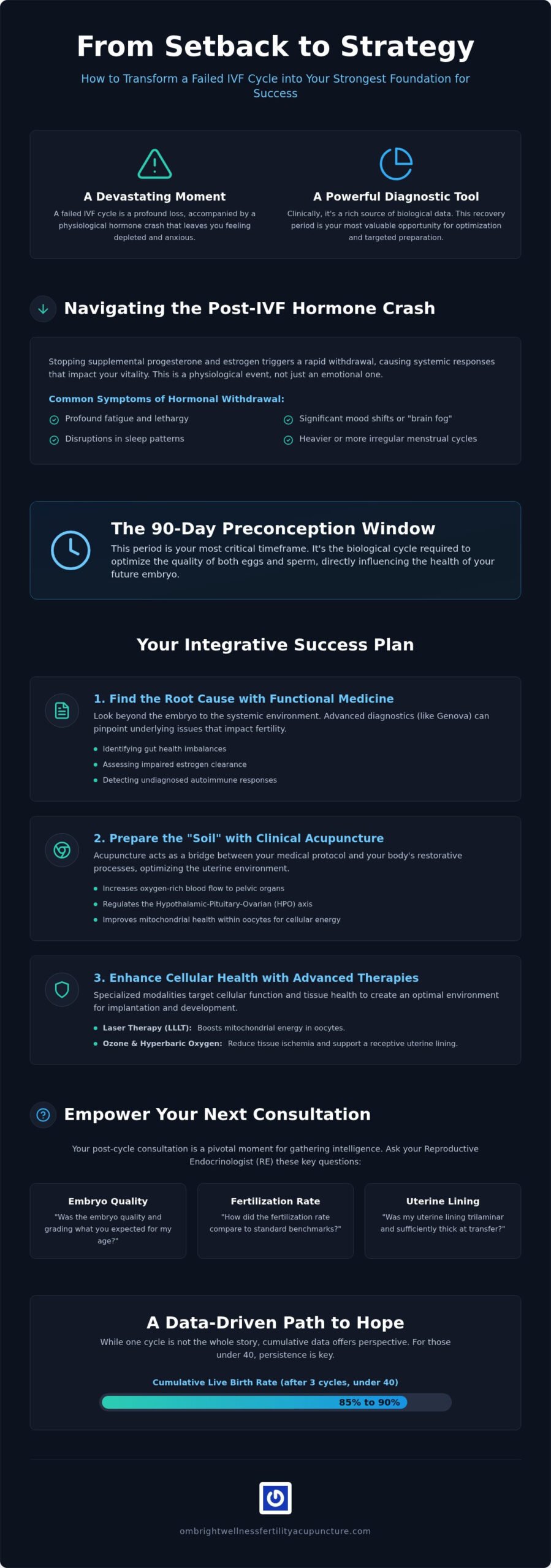
When you stop supplemental progesterone and estrogen after a negative result, your body undergoes a rapid physiological shift. This withdrawal can trigger a range of systemic responses that affect your daily vitality. Common symptoms include:
- Profound fatigue and lethargy
- Significant mood shifts or “brain fog”
- Disruptions in sleep patterns
- Heavier or more irregular menstrual cycles
The hormone crash is a systemic withdrawal that requires neurological regulation. Clinical acupuncture is particularly effective during this phase. It helps reset the endocrine system by modulating the hypothalamic-pituitary-ovarian (HPO) axis, which often becomes dysregulated after high-dose medications. This gentle intervention encourages the body to return to its natural rhythm, reducing the duration of physical recovery.
Analyzing the Why with Your Medical Team
The post-cycle consultation with your Reproductive Endocrinologist (RE) is a pivotal moment for gathering intelligence. This meeting shouldn’t just be about moving to the next round; it’s about dissecting the specific variables of the failed cycle. By applying the principles of functional medicine after failed IVF, we can investigate whether the failure was a matter of statistical “bad luck” or a recurring systemic issue, such as an undiagnosed autoimmune response or poor mitochondrial health. Key questions to ask your RE include:
- Was the embryo quality and grading what you expected for my age?
- How did the fertilization rate compare to standard benchmarks?
- Was my uterine lining trilaminar and sufficiently thick at the time of transfer?
These answers provide the roadmap for your holistic support plan, ensuring your next steps are based on evidence rather than guesswork.
Preparing the Soil: How Fertility Acupuncture Optimizes the Next Cycle
Following the hormone withdrawal discussed in the previous section, the clinical focus shifts toward rebuilding and systemic optimization. Fertility acupuncture serves as a vital bridge between your medical protocol and your body’s natural restorative processes. By facilitating vasodilation in the uterine arteries, acupuncture increases oxygen-rich blood flow to the pelvic organs. This enhanced perfusion is essential for supporting the endometrium and improving the recruitment of follicles. When we utilize functional medicine after failed IVF, we can better assess how these circulatory improvements address specific barriers to success, such as poor egg quality or a thin uterine lining.
Acupuncture also plays a critical role in regulating the hypothalamic-pituitary-ovarian (HPO) axis. This internal feedback loop often becomes strained under the pressure of high-dose stimulation medications. By restoring balance to this axis, we encourage more predictable cycle regularity and improved mitochondrial health within the oocytes. This cellular energy is fundamental for successful fertilization and early embryonic development. Restoring this balance helps the body move past the “hormone crash” and into a state of readiness.
Optimizing Uterine Lining and Receptivity
A thin or unreceptive uterine lining is a frequent obstacle in assisted reproduction. Clinical evidence suggests that targeted acupuncture can improve lining thickness and quality by reducing vascular resistance in the uterine environment. To achieve the most significant impact on cellular turnover, it’s ideal to begin sessions at least 90 days before a planned transfer. This three-month window aligns with the natural cycle of follicle maturation. For those seeking holistic support for IVF patients Miami, this proactive approach ensures the “soil” is fully prepared before the next embryo is placed.
Nervous System Regulation in Miami-Dade
The emotional toll of a failed cycle contributes to a high allostatic load, which is the cumulative wear and tear on the body due to chronic stress. In the fast-paced environment of Miami-Dade, this burden can be particularly heavy, often keeping the body in a state of sympathetic dominance. Acupuncture helps shift the body into a parasympathetic “rest and digest” mode. This transition is crucial for reproductive health, as chronic stress can divert blood flow away from the pelvic region and toward the extremities.
We often enhance this neurological reset by integrating sound therapy and hypnotherapy. These modalities provide a multi-sensory experience that calms the nervous system more deeply than traditional relaxation alone. If you’re ready to begin this transition, exploring specialized fertility acupuncture in Miami can be a restorative first step in your journey toward success. Integrating these therapies alongside functional medicine after failed IVF creates a comprehensive environment for both physical and emotional healing.
Advanced Supportive Therapies: Laser, Ozone, and Hyperbaric Oxygen
While traditional protocols focus on hormonal suppression and stimulation, advanced bio-optimization tools address the cellular foundations of reproductive success. A failed cycle often indicates that standard methods did not fully resolve underlying issues like poor mitochondrial function or chronic tissue ischemia. By incorporating functional medicine after failed IVF, we can implement high-tech therapies that target these systemic barriers. These modalities are increasingly becoming the standard in integrative care because they offer a non-invasive way to improve the biological environment before the next embryo transfer.
Boosting Cellular Energy with Laser Therapy
Fertility Laser Therapy, also known as Low-Level Laser Therapy (LLLT), utilizes specific wavelengths of light to stimulate the mitochondria within the oocytes. This process increases the production of adenosine triphosphate (ATP), the primary energy source for cellular repair and division. Because the human egg contains more mitochondria than any other cell in the body, its energy requirements are immense. LLLT is particularly beneficial for patients facing challenges related to advanced maternal age or a history of poor embryo development. Since national success rates for IVF using own eggs can drop to 13.3% for those aged 41 to 42, boosting cellular energy becomes a clinical priority. During a session in our Miami clinic, the application is entirely painless and focused on improving the bio-energetic potential of the reproductive system.
Ozone and Hyperbaric Oxygen for the Uterine Environment
A receptive uterine environment requires more than just the correct thickness of the lining; it requires optimal oxygenation. Hyperbaric Oxygen Therapy (HBOT) involves breathing pure oxygen in a pressurized chamber, which hyper-oxygenates the blood plasma and reproductive tissues. This process reduces ischemia and encourages the growth of healthy new capillaries in the endometrium. When tissues are well-oxygenated, they’re more capable of supporting the complex process of embryo implantation.
Ozone therapy complements this by reducing systemic oxidative stress and modulating the immune response. This is especially valuable for patients with inflammatory conditions like endometriosis or PCOS, where chronic inflammation can hinder receptivity. These therapies work in tandem to create a calm, nutrient-rich environment for your next cycle. To understand how these tools fit into a broader plan, you can explore our guide to non-invasive fertility treatment Miami. Utilizing functional medicine after failed IVF ensures that every supportive therapy is tailored to your specific physiological needs, moving you closer to a successful outcome.
Functional Medicine: Finding the Root Cause of IVF Failure
Standard fertility diagnostics often focus on a narrow window of data, such as AMH and FSH levels. While these metrics are essential for cycle planning, they don’t reveal the systemic hurdles that may be preventing a successful pregnancy. Utilizing functional medicine after failed IVF allows us to look at the broader picture, identifying biochemical imbalances that standard tests might overlook. This approach investigates how your gut health, environmental toxic load, and chronic low-grade infections influence your reproductive potential. It’s about shifting the perspective from “what” happened to “why” it happened.
By examining hidden triggers like heavy metals, mold exposure, or latent viral loads, we can address the underlying inflammation that often hinders embryo implantation. These factors can create an “alarm” state in the immune system, making the uterine environment less hospitable. Addressing these root causes doesn’t just support your next cycle; it improves your overall vitality and systemic harmony.
Advanced Diagnostic Testing with Genova Labs
Recurrent failure often warrants a deeper investigation into the body’s internal environment. By using advanced Genova labs, we can perform comprehensive stool analyses to assess the estrobolome, which is the collection of gut bacteria responsible for metabolizing and clearing estrogen. If your body isn’t clearing hormones efficiently, it can lead to imbalances that affect uterine receptivity and egg quality. Organic acid testing further clarifies how your body processes nutrients and identifies markers for oxidative stress. Functional medicine is a root-cause approach to systemic fertility health that prioritizes the optimization of every biological pathway. We interpret these results through the lens of reproductive optimization, ensuring your body is in a state of peak readiness rather than just the absence of clinical disease.
Peptide and Nutrient Optimization
Once we’ve gathered data from functional diagnostics, we can create a highly personalized intervention plan that goes beyond standard prenatal vitamins. Peptide therapy is a modern innovation that uses specific amino acid sequences to improve hormonal signaling and support tissue repair. These targeted signals can help “fine-tune” the reproductive environment, encouraging better cellular communication and recovery after the physical toll of an IVF cycle.
Additionally, fertility IV therapy provides a direct route for delivering high-dose antioxidants like glutathione. By bypassing the digestive tract, these nutrients reach the cellular level immediately, helping to neutralize the oxidative stress that often follows intensive stimulation protocols. This precision allows us to customize your supplement and nutrient protocol based on hard data from your functional labs. If you’re ready to look beneath the surface of your results, you can schedule a functional medicine consultation in Miami to begin your diagnostic deep dive. This data-driven approach ensures that your next steps are both intentional and clinically supported.
Next Steps: Building Your Integrative Success Plan in Miami
Transitioning from the diagnostic phase to an actionable plan is the most empowering step in your recovery. While the urge to immediately begin another cycle is common, taking a deliberate pause to optimize your internal environment often yields more resilient results. This three-month period is vital because it aligns with the 90-day window required for oocyte maturation. By utilizing functional medicine after failed IVF during this timeframe, we can influence the cellular health and mitochondrial energy of the eggs that’ll be recruited in your next attempt.
Our specialists in Miami prioritize a collaborative approach, working alongside your Reproductive Endocrinologist (RE) to ensure your holistic therapies complement your medical protocol. We don’t replace your medical team; we provide the systemic support that makes their interventions more likely to succeed. This partnership ensures a seamless experience as you move between clinical procedures and restorative therapies.
The integration of your success plan typically follows a methodical three-step process:
- Step 1: Clinical Consultation and Diagnostic Review. We perform a deep dive into your previous cycle data and functional lab results, whether in-person or via telehealth.
- Step 2: Designing a Multi-Modal Protocol. We’ll create a customized strategy that may include fertility acupuncture, laser therapy, and targeted nutrient support.
- Step 3: Implementation and Monitoring. We track your physiological progress, such as improvements in uterine lining and stress markers, before you proceed to your next transfer.
The Ombright Partnership Mindset
For patients in Coral Gables, Kendall, and the surrounding Miami areas, we offer a sanctuary for both clinical excellence and emotional grounding. We understand that the logistical demands of fertility treatments are taxing. If you’re managing a busy schedule or live further away, our telehealth options for functional medicine and nutritional guidance ensure you don’t lose momentum in your preparation. Addressing the emotional aftermath of a failed cycle is just as important as the physical protocols. You can explore our resources on mind body fertility support Miami to help regulate your nervous system during this transition.
Your Path Forward: Actionable Next Steps
To begin your recovery and optimization journey, we recommend focusing on a few immediate actions. These steps help shift your focus from past disappointment to future readiness. It’s about taking control of the variables we can influence through modern science and holistic wisdom.
- Schedule a clinical review of your failed cycle from a comprehensive holistic perspective.
- Begin a daily nervous system regulation practice to help your body heal from the trauma of loss.
- Identify one functional diagnostic test, such as a Genova stool analysis, to uncover hidden barriers.
If you’re ready to transform your approach and optimize your body for the road ahead, we’re here to guide you. Book your fertility support consultation in Miami today to start building your personalized success plan.
Transforming Disappointment into Clinical Readiness
While a failed cycle is undoubtedly difficult, it’s also a powerful catalyst for a more precise, data-driven approach to your reproductive health. By utilizing the 90-day window before your next transfer, we can actively improve mitochondrial energy and uterine receptivity through advanced modalities like Fertility Laser Therapy and Hyperbaric Oxygen. Integrating functional medicine after failed IVF allows us to move beyond standard metrics, identifying hidden inflammatory triggers and gut health imbalances that may have hindered your previous results.
Our specialized team in Miami works in a close integrative partnership with your Reproductive Endocrinologist to ensure every holistic intervention aligns with your clinical goals. We specialize in post-IVF recovery, providing the systemic support needed to transition from the exhaustion of a hormone crash to a state of vibrant readiness. You don’t have to navigate this complex journey alone; a methodical and supportive path forward is available to you.
If you’re ready to build an optimized foundation for your next cycle, we invite you to Schedule Your Fertility Support Consultation in Miami today. Your resilience is the starting point for your future success.
Frequently Asked Questions
How long should I wait after a failed IVF cycle before starting acupuncture?
You can ideally begin acupuncture as soon as your withdrawal bleed starts to help regulate the endocrine system. Initiating care within the first one to two weeks after a failed cycle allows us to address the immediate hormone crash and systemic inflammation. This early intervention supports the HPO axis and prepares your body for the 90-day maturation window of the next follicle cohort.
Can acupuncture really improve egg quality for my next retrieval?
Clinical acupuncture supports egg quality by increasing micro-circulation to the ovaries, which ensures a steady supply of nutrients and oxygen to the follicles. This process is essential for mitochondrial health and ATP production within the oocyte. By reducing oxidative stress and regulating the nervous system, we create a more stable and nutrient-rich environment for follicular development over the three months leading up to your next retrieval.
Is it safe to do ozone or laser therapy during an active IVF stimulation cycle?
Ozone and laser therapies are highly effective during the preparation phase, but we typically pause certain intensive protocols once active stimulation begins. We coordinate closely with your Reproductive Endocrinologist to ensure that any supportive therapy, such as Fertility Laser Therapy, is used at the optimal time to boost mitochondrial energy without interfering with your medical team’s specific stimulation protocol and follicle monitoring.
What are the most common functional medicine tests for recurrent IVF failure?
We frequently utilize Genova labs for comprehensive stool analysis to assess the estrobolome and gut-mediated inflammation. Other essential tools in functional medicine after failed IVF include organic acid testing to evaluate metabolic function and specialized panels to check for heavy metals or environmental toxins. These diagnostics help us uncover root causes of failure that standard blood work, such as FSH or AMH levels, might not reveal.
Do you offer remote support if I am not located in Miami?
We provide Fertility Telehealth Consultations for patients who aren’t able to visit our Miami clinic in person. These sessions focus on reviewing your cycle history, interpreting functional labs, and designing a customized nutritional and supplement protocol. While physical modalities like acupuncture require an in-person visit, we can provide comprehensive guidance on functional medicine after failed IVF to support your systemic health from any location.
How many acupuncture sessions are typically needed after a failed transfer?
For most patients, we recommend one to two sessions per week for a minimum of 8 to 12 weeks following a failed transfer. This frequency is based on the biological timeline required for cellular turnover and the regulation of the nervous system. Consistent treatment helps rebuild the uterine lining and ensures that systemic inflammation is addressed before you move forward with another embryo transfer or retrieval cycle.
What is the hormone crash and how can I manage the symptoms naturally?
The hormone crash is the physiological shift that occurs when stopping supplemental progesterone and estrogen, often leading to fatigue and mood swings. You can manage these symptoms naturally by prioritizing anti-inflammatory nutrition, utilizing sound therapy for nervous system regulation, and ensuring adequate hydration. Acupuncture is also a primary tool for resetting the endocrine system and helping the body process these synthetic hormones more efficiently during your recovery.
Can hyperbaric oxygen therapy help with a thin uterine lining?
Hyperbaric Oxygen Therapy (HBOT) can be highly effective for a thin uterine lining by hyper-oxygenating the blood and stimulating angiogenesis, which is the formation of new blood vessels. This increased perfusion helps build a thicker, more receptive endometrial environment. By reducing tissue ischemia, HBOT ensures that the lining has the necessary oxygen and nutrients to support successful embryo implantation in your next planned cycle.