
A peptide plan should not stand alone as a sperm-health strategy. For men in Key West considering peptide therapy for sperm quality, the key question is how it fits with an assessment of reproductive and overall health.
Peptides are short chains of amino acids that can act as signals in the body. It’s understandable to want a clear answer about whether they may help, how treatment is scheduled, and what risks to weigh before making a decision.
This article explains what peptide therapy involves and why it should be considered in the context of semen and hormone health, rather than as a guaranteed fix. You’ll learn about typical treatment schedules, possible risks, and how a broader men’s health plan may address other factors that influence sperm quality. The goal is a grounded starting point for understanding your options and the questions that matter in a thoughtful care plan.
Key Takeaways
- Understand why peptide choice, product sourcing, and individual health factors matter when weighing possible benefits and risks.
- See how treatment schedules and follow-up testing can be planned around the time needed to assess changes in sperm health.
- Learn why testosterone replacement therapy may affect fertility and which fertility-sparing hormone approaches are discussed.
- Explore how peptides may fit alongside broader fertility support, including acupuncture, IV therapy, and ozone therapy.
What are the side effects and risks?
Peptide therapy is not one standardized treatment: its potential role depends on the specific compound and intended use. A semen analysis alone may not tell the whole story. For example, elevated sperm DNA fragmentation can impair fertilization and embryo development even when semen analysis results are normal. Peptide therapy should not replace an evaluation of possible infertility causes. Treatment planning needs to reflect the specific fertility concern, since peptide therapy does not have one established role across diagnoses.
Safety questions also depend on the product. The FDA flagged BPC-157, CJC-1295, TB-500, GHK-Cu, MOTS-c, AOD-9604, epitalon, and thymosin alpha-1 for immunogenicity risk and limited human safety data in its compounding-list review. This makes the precise peptide clinically relevant, rather than treating all peptides as interchangeable. Possible unwanted effects may vary by compound and how it is administered, so a general safety claim cannot apply to every protocol.
Product sourcing is also important. Identify the exact peptide being prescribed and the compounding pharmacy that prepares it. The pharmacy’s name should appear on the vial, according to the product-sourcing guidance provided. These details distinguish a specific prescribed product from a vague description such as “peptide blend.” If the compound or its source is unclear, assessing its safety profile becomes more difficult.
Testosterone replacement therapy (TRT) raises a distinct fertility concern: it can suppress sperm production. This matters if you want children now or may want them later. A treatment intended to improve testosterone-related symptoms can conflict with fertility goals, so discuss reproductive plans and the impact on sperm production before considering TRT. Peptide therapy and TRT are not interchangeable, and neither should be assumed to improve sperm quality simply because it affects hormone-related pathways. A fertility-focused plan weighs intended benefits against reproductive safety.
Health Canada’s advisory on injectable peptides such as BPC-157 was issued in April 2026. Ask which exact peptide is being prescribed and which pharmacy compounds it, with the pharmacy name shown on the vial, to keep product identification part of the safety discussion.
Treatment schedules and cycle duration
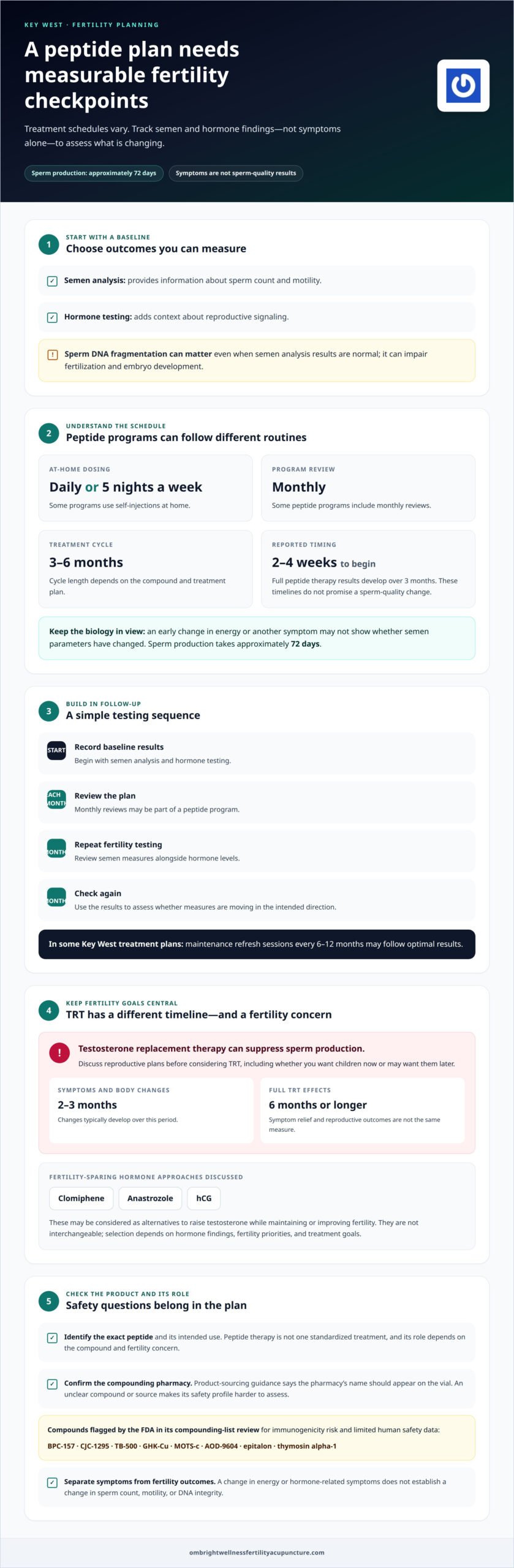
Peptide schedules depend on the compound and treatment plan. Some programs involve self-injections at home daily or five nights a week, with monthly reviews and cycles lasting 3 to 6 months. Results may begin in 2 to 4 weeks, while full peptide therapy results develop over 3 months. These timelines describe reported treatment schedules, not a promise of a sperm-quality change.
Sperm production takes approximately 72 days, so an early change in energy or another symptom may not show whether semen parameters have changed. A fertility-focused plan can include repeat semen analysis and hormone testing at 3 and 6 months. Those checkpoints help assess sperm measures alongside hormone levels, rather than relying on how a person feels. Maintenance refresh sessions every 6 to 12 months may follow optimal results in some Key West treatment plans.
TRT has a different timeline and requires careful consideration of fertility goals. Changes in body composition, libido, and other symptoms typically develop over two to three months; full effects can take six months or longer. Since TRT can suppress sperm production, symptom relief and reproductive outcomes are not the same measure. When future fertility matters, monitoring should consider both the intended hormone-related outcome and semen findings.
For some men, fertility-sparing hormone treatments may be considered instead of TRT. Clomiphene, anastrozole, and hCG are used as alternatives to raise testosterone while maintaining or improving fertility. These are not interchangeable options: the choice depends on hormone findings, fertility priorities, and treatment goals. Follow-up testing can help assess whether hormone levels and semen results are moving in the intended direction.
A practical schedule links each treatment step to a measure. At the start, record baseline semen analysis and hormone testing; review the plan monthly if using a peptide program; then repeat fertility tests at 3 and 6 months. This timing respects sperm production’s 72-day cycle and gives the plan defined points for assessment, rather than treating a short-term symptom change as proof of improved sperm quality.
Peptide therapy as part of a broader men’s health plan
A fertility plan starts with a measurable outcome, not a general promise of “optimization.” Semen analysis provides information about sperm count and motility, while hormone testing adds context about reproductive signaling. Elevated sperm DNA fragmentation can impair fertilization and embryo development even when semen analysis results are normal. This is one reason a single result cannot represent every aspect of sperm quality. Peptide therapy should be discussed in the broader context of findings, goals, and measurable outcomes.
Evidence that a peptide affects energy or hormone-related symptoms is not the same as evidence that it improves sperm quality. A plan should distinguish these outcomes rather than treating them as interchangeable. A reported change in energy, for instance, does not establish a change in sperm count, motility, or DNA integrity. Semen analysis and hormone testing provide different measures to follow. The key question is whether the therapy has a clear, relevant role alongside them.
Other parts of a men’s health plan can address nutritional factors. Coenzyme Q10, vitamin D, and zinc are specific micronutrients supported for improving sperm count, motility, and DNA integrity. That does not make every supplement appropriate for every person. A considered plan connects a nutrient to the relevant health context and avoids stacking products without a clear purpose. The same approach applies to peptides: name the intended target and the outcome used to assess it.
Coordination matters when fertility treatment is also being considered. Before IVF or ICSI, optimizing sperm quality is described as a way to improve fertilization rates and embryo quality. A plan can align discussions about peptide therapy, nutrition, hormone findings, and semen results with the timing of fertility treatment. TRT requires particular care because it can suppress sperm production, so fertility goals should inform hormone decisions. Evaluate peptide therapy by its role in a measured fertility plan, not by broad claims about men’s health.
Ombright Wellness Fertility Acupuncture: Peptides for Fertility
Ombright Wellness Fertility offers Peptides for Fertility as one option within a broader fertility-focused care plan. For men considering peptide therapy for sperm quality in Key West, the important discussion is how treatment relates to sperm and hormone findings, personal fertility goals, and other health considerations. Peptide therapy is not a substitute for assessing sperm health, nor does it promise a particular result.
A useful starting point is to connect the treatment question to specific information, such as semen analysis or hormone testing. These measures help clarify the goal, whether it is addressing a hormone-related concern, reviewing sperm parameters, or considering fertility support alongside other care. Peptides for Fertility can be part of that conversation without treating every fertility concern as the same problem.
Ombright also offers Fertility Acupuncture, Fertility IV Therapy, and Fertility Ozone Therapy. These are distinct services, not interchangeable treatments. Fertility Acupuncture is delivered by an NCCAOM-Certified Diplomate of Acupuncture and may be considered as an integrative option alongside a broader fertility plan. IV and ozone therapy are separate offerings for people exploring additional fertility support. The appropriate role of each depends on the person’s goals and health context.
For example, a man reviewing semen and hormone findings can use those priorities to guide a discussion of peptide therapy and other available services. A clear plan keeps the intended outcome in view and distinguishes supportive care from fertility assessments. If a partner’s treatment timeline is also involved, coordinated planning can help keep the focus on shared reproductive goals rather than a single intervention.
Choosing an integrative approach is a personal decision. A focused conversation can help clarify which concerns matter most, what each service involves, and how it may fit with existing fertility care. Ombright Wellness Fertility Acupuncture welcomes questions from people weighing these options. Contact Ombright Wellness Fertility Acupuncture to discuss your fertility care.
Frequently Asked Questions
What Are Peptides?
Peptides are short chains of amino acids, the building blocks of proteins. Some act as signals in the body and influence biological processes, including hormone-related activity. Their effects depend on the specific peptide, so “peptide therapy” describes a broad category rather than one uniform treatment. A plan involving one named peptide, for example, cannot be assumed to work like a plan involving another.
Are peptides injected or taken orally?
How peptides are administered depends on the specific compound and prescribed plan. Some programs use self-injections at home, but the route cannot be assumed from the word “peptides” alone. Ask what form is prescribed and follow its directions. If the product is injectable, note its exact name and the compounding pharmacy listed on the vial.
How long does peptide therapy take to show results?
Reported peptide therapy programs may show early changes in 2 to 4 weeks, with full results developing over 3 months. The timing of a symptom change, such as energy, does not establish a change in fertility. For a practical example, sperm-related outcomes need to be assessed with semen testing, not inferred from feeling different during treatment.
What evidence supports peptide therapy for improving sperm count, motility, and morphology?
Evidence depends on the specific peptide, and the information available here does not establish that peptide therapy improves sperm count, motility, or morphology. These are separate semen measures, so a change in one would not prove improvement in the others. Men in Key West considering peptide therapy for sperm quality can keep the discussion focused on these measured outcomes rather than broad claims about vitality or hormones.
What are the risks and side effects of fertility peptide therapy?
Risks vary with the peptide and product source. The FDA has flagged limited human safety data and immunogenicity concerns for compounds including BPC-157, CJC-1295, and TB-500 in its compounding-list review. Before treatment, identify the exact compound and pharmacy. Keep a record of the product name and any new symptoms, so concerns can be discussed in the context of the specific treatment.
Are both men and women treated for fertility concerns?
Yes. Ombright Wellness Fertility Acupuncture provides fertility services for men and women, including support for male fertility concerns such as sperm quality and motility. Care can address reproductive health from either partner’s perspective. Couples exploring fertility support can discuss male and female factors together, rather than assuming evaluation or care applies to only one partner.