
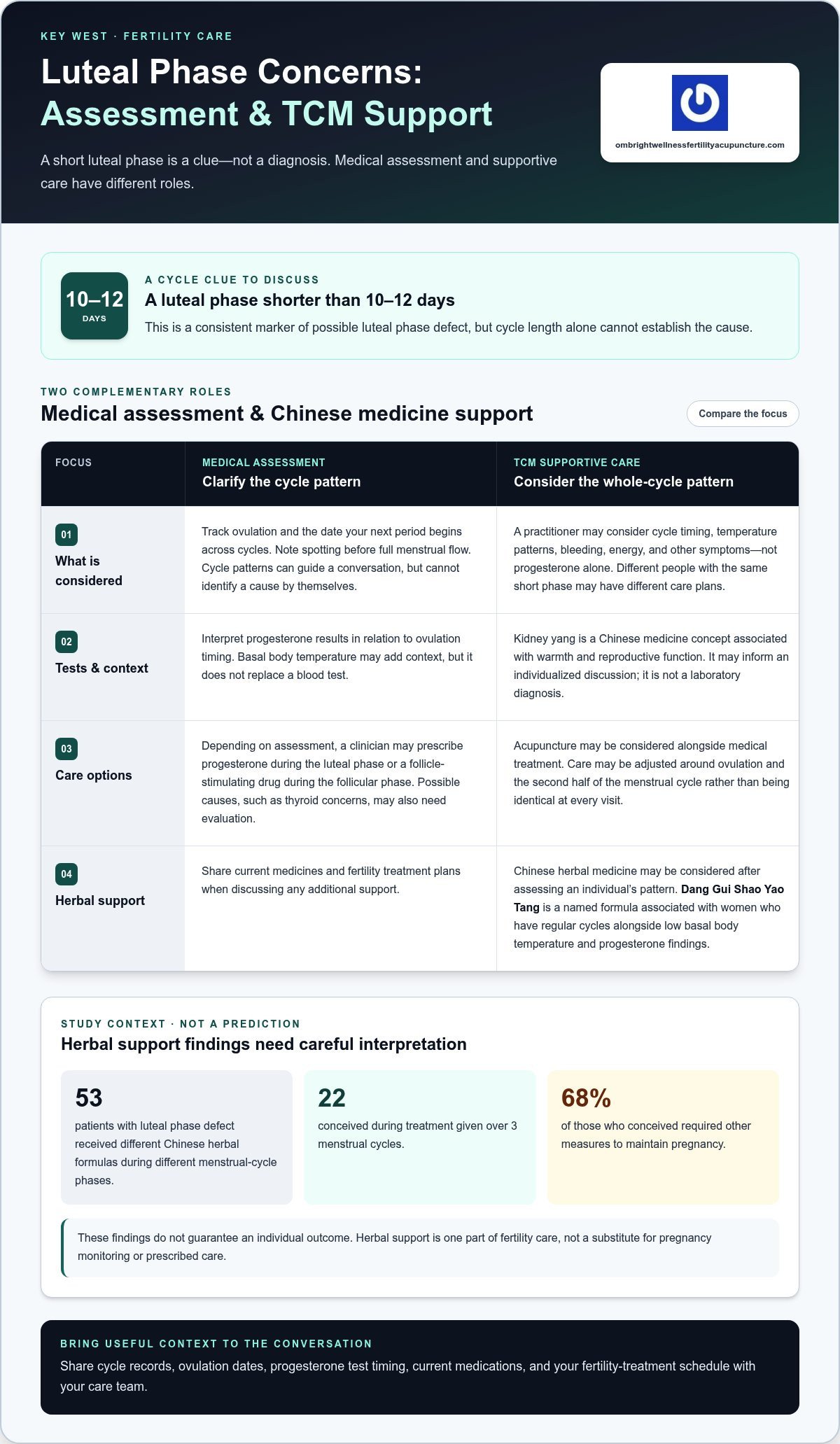
A short luteal phase is a clue, not a diagnosis. A luteal phase shorter than 10-12 days is among the most consistent markers of luteal phase defect, and assessment may also consider ovulation timing, progesterone levels, and cycle patterns. Acupuncture for luteal phase defect in Key West may be considered as supportive care, alongside a clear medical assessment.
If you’re tracking cycles or noticing spotting before your period, it’s understandable to wonder whether progesterone support could help. This article explains how luteal phase defect is assessed and what acupuncture and Chinese herbs may contribute to luteal phase and progesterone support, without treating supportive therapies as a substitute for diagnosis or prescribed care.
You’ll learn which cycle signs may matter, how progesterone testing is timed, and how acupuncture may fit into an individualized fertility plan. The aim is to make the next steps easier to understand and discuss with your care team.
Key Takeaways
- Track the time between ovulation and your period; cycle patterns can help guide a conversation about luteal phase length.
- Progesterone results are most useful when interpreted in relation to ovulation timing, not as an isolated number.
- Traditional Chinese medicine considers individual patterns when planning acupuncture or herbal support for the luteal phase.
- Acupuncture may complement fertility care, while assessment and treatment of underlying causes remain part of the bigger picture.
Traditional Chinese medicine patterns associated with luteal phase defect
Traditional Chinese medicine (TCM) considers luteal phase concerns as part of patterns across the whole menstrual cycle, rather than focusing on progesterone alone. A practitioner may consider cycle timing, temperature patterns, bleeding, energy, and other symptoms before forming a Chinese medicine assessment. Kidney yang is a TCM concept associated with warmth and reproductive function. It may inform an individualized discussion, but it is not a laboratory diagnosis. The same short luteal phase may therefore lead to different care plans for different people.
Medical treatment and acupuncture have different roles. Depending on the assessment, a clinician may prescribe progesterone during the luteal phase or a follicle-stimulating drug during the follicular phase. Acupuncture may be considered as supportive care alongside medical treatment. It does not replace hormone treatment or evaluation of possible causes, such as thyroid concerns.
In Chinese medicine, fertility care may focus on cycle patterns across both phases. For example, treatment may be adjusted around ovulation and the second half of the menstrual cycle, rather than being identical at every visit. Chinese herbal medicine may also be considered after assessing the person’s pattern. Dang Gui Shao Yao Tang is a named formula associated with women who have regular cycles alongside low basal body temperature and progesterone findings. Formula selection should take the person’s symptoms and current medications into account.
Clinical findings offer context, not a guarantee for an individual. In one study, 53 patients with luteal phase defect received different Chinese herbal formulas during different menstrual-cycle phases. Twenty-two conceived, and treatment was given over 3 menstrual cycles; among those who conceived, 68% required other measures to maintain pregnancy. These results underscore why herbal support should be understood as one part of fertility care, not a substitute for pregnancy monitoring. For a useful discussion, bring cycle records and progesterone test timing to the conversation, then consider how TCM support might fit with the medical plan.
How do I know if I have luteal phase defect?
A cycle record can help identify patterns, but it cannot establish a cause by itself. A luteal phase shorter than 10-12 days is a consistent marker of possible luteal phase defect. Track ovulation and the date your next period begins across cycles. Note any spotting before full menstrual flow, and bring those observations to a medical appointment.
Research on acupuncture and fertility includes studies of ovarian response, luteal function, and IVF outcomes. One reported comparison found pregnancy rates improved two-fold during a four-month treatment period compared with fertility drugs and/or IVF. That finding does not establish acupuncture as a treatment for every cause of infertility or predict an individual outcome. Research specifically focused on luteal phase defect remains limited.
Stress management can be part of general reproductive health care. Track sleep, stress, and cycle patterns alongside ovulation dates. These notes may help make discussions about hormone production more specific.
Does insurance cover acupuncture for fertility treatment in Florida? Review your plan’s written benefits for acupuncture and fertility care, and follow its process for questions about coverage.
What does research say about acupuncture for luteal phase defect? Studies report possible effects on fertility and luteal function, but do not establish acupuncture as a stand-alone treatment for this condition.
What are the risks and side effects of acupuncture when trying to conceive? Discuss possible risks and side effects before treatment, and share your health history, medications, and fertility-treatment schedule. This gives the practitioner useful context for discussing acupuncture while you’re trying to conceive.
When should someone with a suspected luteal phase defect see a reproductive endocrinologist? Arrange an evaluation if cycle tracking repeatedly suggests a short luteal phase, or if infertility or early pregnancy loss is a concern. Bring cycle dates and any progesterone test results to help focus the discussion.
Can acupuncture and Chinese herbs improve progesterone levels?
Acupuncture and herbal medicine may be considered as supportive approaches, while cycle tracking and correctly timed testing help assess progesterone function. Basal body temperature can provide context, but it does not replace a blood test.
Basal Body Temperature and Progesterone
Basal body temperature is your resting temperature, charted each morning to observe menstrual-cycle patterns. Progesterone is associated with a temperature rise after ovulation, so a sustained shift may help identify a possible ovulatory pattern. A chart is most useful alongside ovulation dates and period start dates. A temperature chart is only one part of understanding progesterone patterns and uterine-lining support.
Acupuncture and Progesterone Regulation
Acupuncture is a supportive therapy studied for possible effects on reproductive hormones and fertility. A prospective study around embryo transfer reported improved hormonal profiles, including progesterone. That finding concerns treatment alongside embryo transfer; it does not prove that acupuncture alone corrects luteal phase defect. For someone hoping to conceive, acupuncture may complement a medical plan, while test results and the underlying cause guide decisions about hormone treatment.
Chinese herbs have also been studied for luteal phase concerns, with formulas selected according to menstrual-cycle timing and the individual’s pattern. Herbal treatment should be coordinated with fertility care, especially when prescription hormones or other medicines are involved. A temperature chart can provide another observation, but it cannot show whether an herbal approach changed progesterone levels.
Luteal Phase and Progesterone
The luteal phase begins after ovulation, and progesterone helps prepare the uterine lining for implantation. A mid-luteal blood test is generally timed seven days after confirmed ovulation, rather than on a fixed calendar day. A progesterone level below 30 nmol/L, equivalent to 10 ng/mL, seven days after confirmed ovulation is described as indicative of an inadequate luteal phase. Levels between 30 and 60 nmol/L may suggest suboptimal luteal function. Discuss results in relation to ovulation timing, cycle patterns, and any treatment already underway.
Acupuncture and luteal phase support
Acupuncture may complement luteal phase care by supporting ovarian function and uterine blood flow. In practice, consider how treatment fits around ovulation, implantation planning, and evaluation of possible underlying causes.
Can acupuncture improve luteal phase defect or fertility outcomes? Studies report possible benefits for ovarian response and luteal function, but do not establish acupuncture as a stand-alone treatment for every cause of luteal phase defect. It is best understood as supportive care alongside appropriate fertility assessment.
Treatment timing may reflect the menstrual cycle. One case history describes acupuncture twice per month: one treatment before ovulation and another after ovulation. This approach distinguishes support for follicular development from care during the luteal phase, when progesterone helps prepare the uterine lining. Treatment plans may also consider cycle records, hormone findings, and whether conception is spontaneous or part of fertility treatment.
The comparison group included 45 women receiving hormone treatment. The groups were matched for infertility duration, age, body mass index, previous pregnancies, menstrual cycle, and tubal patency. The study offers relevant context, but its participants and design do not show that acupuncture alone can correct every underlying cause.
Other research describes electroacupuncture improving uterine blood flow and ovarian function, while a systematic review reported improvements in ovarian response and luteal function among women with infertility. A PLOS One study also reported increased uterine artery blood flow after acupuncture. These findings help explain why acupuncture is considered for reproductive support, but changes in blood flow do not by themselves confirm implantation or pregnancy.
For a practical next step, discuss cycle timing and current fertility treatment with an acupuncture practitioner. Explore fertility acupuncture support as part of a coordinated plan.
Ombright Wellness Fertility Acupuncture: Fertility Acupuncture
Ombright Wellness Fertility Acupuncture offers Fertility Acupuncture as supportive care alongside assessment for luteal phase concerns. Treatment can be part of a fertility plan, with timing and goals discussed in relation to your needs and other care.
Additional services include Fertility IV Therapy, Fertility Ozone Therapy, and Fertility Hyperbaric Oxygen Therapy. These are supportive options, not substitutes for diagnosis or prescribed treatment. Cycle notes, relevant test results, and details of your current treatment can help focus a discussion about which support may fit your fertility goals.
Plan Your Next Fertility Conversation
A useful next step is to turn your observations into clear priorities. Consider what you want to understand, such as whether further assessment is appropriate, how supportive therapies might fit with your current care, or what progress would mean for your fertility goals. This can keep the conversation focused and leave room for the questions that matter to you.
If you’re considering acupuncture for luteal phase defect in Key West, think about how complementary care could work alongside your medical plan. Discuss your treatment goals, coordination with fertility care, and how to review changes over time. A thoughtful conversation can help you make informed, manageable decisions.
Every fertility journey has its own context. Let your questions guide the next discussion, and give yourself room to weigh your options carefully.
Frequently Asked Questions
How long does treatment take?
Many patients begin with a three-month fertility acupuncture plan, aligned with the reproductive cycle. For acupuncture for luteal phase defect in Key West, treatment timing depends on your goals, cycle patterns, and whether acupuncture accompanies other fertility treatment. Keep notes on cycle changes and session dates so you can discuss them with your care team.
What is luteal phase defect and how is it diagnosed?
Luteal phase defect refers to concerns with the post-ovulation phase of the menstrual cycle, such as a consistently short phase or inadequate progesterone support. Assessment combines cycle history, ovulation timing, and appropriately timed progesterone testing. A clinician also considers possible contributing factors, rather than diagnosing the condition from spotting or a temperature chart alone.
How often and for how long is acupuncture typically used for fertility?
Fertility acupuncture schedules are tailored to cycle timing, treatment goals, and whether care accompanies natural conception, IUI, or IVF. Some plans coordinate visits with key stages of the menstrual cycle or fertility treatment, while many patients begin with a three-month plan. Share your treatment calendar and relevant health information so sessions can be coordinated with your broader care.
Which licensed acupuncturists in Key West offer fertility or reproductive health services?
Ombright Wellness Fertility Acupuncture offers Fertility Acupuncture for people seeking reproductive health support in Key West and across Miami, Coral Gables, Kendall, Cutler Bay, Homestead, Pinecrest, Coconut Grove, South Beach, and Brickell. If you’re considering acupuncture for luteal phase defect in Key West, the practice identifies an NCCAOM-Certified Diplomate of Acupuncture. Fertility Telehealth Consultations are also available to discuss your goals and care planning alongside your existing care.