Can acupuncture deliver IVF-like success rates, or is its role better understood as support alongside fertility treatment? That question is at the heart of acupuncture vs IVF success rates Homestead, especially when research headlines point in different directions. A 2023 meta-analysis of 25 randomized trials reported higher live birth rates among participants who received acupuncture during IVF. Findings across studies remain mixed, however, and do not predict an individual result.
It’s understandable to want one clear number when making personal decisions about fertility care. Yet IVF and acupuncture serve different roles, and their outcomes cannot be compared fairly unless the measure, patient group, and treatment context are similar. A clinical pregnancy rate, for example, is not the same as a live birth rate.
This article explains what IVF success figures measure, why rates vary by age and other factors, and what current evidence can and cannot tell you about acupuncture alongside IVF. It also looks at how fertility acupuncture may fit into an individualized care plan in Homestead without replacing reproductive treatment or promising a particular outcome. You’ll find practical questions to discuss with your reproductive care team as you consider your options.
Key Takeaways
- Compare success figures only when they track the same outcome and similar patient groups. Pregnancy and live birth rates answer different questions.
- Understand why acupuncture vs IVF success rates Homestead is a comparison of distinct roles, not interchangeable treatments.
- Review what research suggests about acupuncture alongside IVF while keeping mixed findings and individual differences in view.
- Use practical questions to coordinate supportive acupuncture care with your reproductive medical team.
- Consider how individualized fertility acupuncture may support people pursuing natural conception or IVF without promising a particular outcome.
Acupuncture vs. IVF success rates: what are you actually comparing?
Can acupuncture achieve the same success rates as IVF? The two cannot be compared like-for-like: IVF is a medical fertility treatment, while fertility acupuncture is supportive care that may accompany fertility treatment. The In vitro fertilisation (IVF) process involves fertilizing an egg outside the body and transferring an embryo to the uterus. Acupuncture studies, by contrast, may assess acupuncture as an added intervention during a fertility treatment cycle. When considering acupuncture vs IVF success rates Homestead, start by checking what each figure actually counts.
Why there’s no single universal rate: A rate depends on the outcome measured, who was included, the treatment setting, and the denominator. A live birth rate per intended egg retrieval cannot be directly compared with a pregnancy rate per embryo transfer or a measure of stress or well-being.
What does an IVF success rate measure?
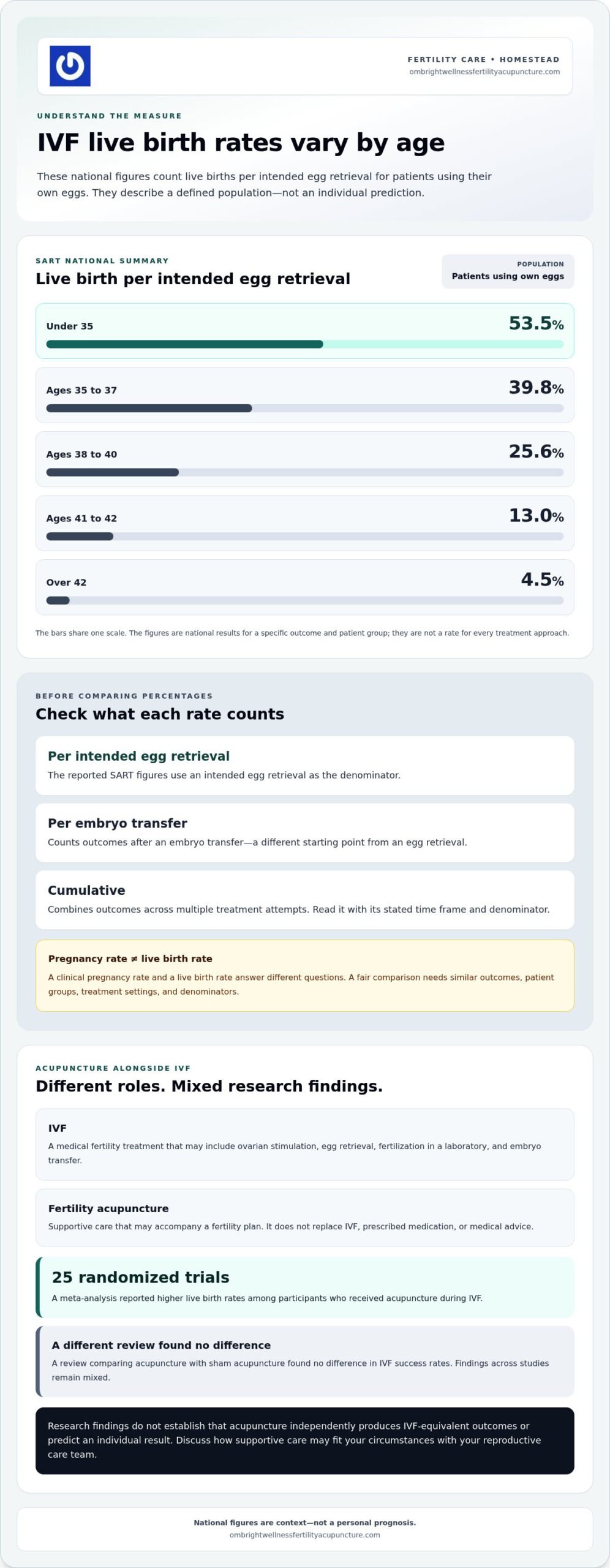
“Per cycle,” “per transfer,” and “cumulative” describe different ways of counting outcomes. A per-transfer rate counts outcomes after an embryo transfer; a per-cycle figure may use a different starting point. Cumulative rates combine outcomes across multiple treatment attempts, so interpret them using their stated time frame and denominator.
The SART 2022 National Summary Report presents live birth rates per intended egg retrieval for patients using their own eggs, with results grouped by age: 53.5% for patients under 35, 39.8% for ages 35 to 37, 25.6% for ages 38 to 40, 13.0% for ages 41 to 42, and 4.5% for those over 42. These are national figures for a defined population and outcome, based on 2022 data. They are not a prediction for an individual or a rate for every treatment approach. Age, diagnosis, embryo factors, and treatment history also affect how a figure applies to someone’s circumstances.
Is acupuncture success measured the same way?
Not always. Research may track clinical pregnancy or live birth, but it may also examine outcomes such as stress or physiological changes. A positive change in stress or another measure does not establish that live birth rates improve. Even studies reporting pregnancy outcomes can differ in their participants, acupuncture timing, IVF context, and follow-up.
For a fair comparison, both figures need to describe similar patient groups, treatment settings, outcomes, and denominators. Without those details, a percentage can sound more definitive than the evidence allows. These distinctions provide a clearer starting point for understanding research on acupuncture alongside IVF.
How IVF and fertility acupuncture differ in purpose and evidence
IVF and fertility acupuncture can be part of the same care journey, but they are not equivalent treatments. IVF is a medical fertility treatment intended to help achieve pregnancy through steps that may include ovarian stimulation, egg retrieval, fertilization in a laboratory, and embryo transfer. Acupuncture may be chosen as supportive care during a fertility journey; it does not perform those steps or replace prescribed treatment.
IVF is a treatment intended to achieve pregnancy; acupuncture is complementary support that may accompany fertility care.
| Area | IVF | Fertility acupuncture |
|---|---|---|
| Purpose | Medical treatment that aims to achieve pregnancy through fertilization outside the body and embryo transfer. | Supportive care that may be integrated into a broader fertility plan. |
| Clinical role | A reproductive treatment pathway guided by clinical circumstances and a fertility team. | Complementary care that should not replace IVF, prescribed medication, or medical advice. |
| Outcome evidence | May be assessed through outcomes such as pregnancy or live birth, with results depending on the population and measure used. | Studies may assess pregnancy outcomes, stress, or physiological measures. These outcomes are not interchangeable. |
| Relationship to care | Forms part of medical fertility treatment. | May accompany medical fertility treatment when coordinated with the reproductive care team. |
What role does IVF play in fertility treatment?
IVF treatment pathways vary according to a person’s health, diagnosis, treatment history, and clinical findings. A general description or published success figure cannot establish an individual prognosis. For guidance that reflects your circumstances, discuss the treatment plan and outcome measures with your reproductive endocrinology team.
What can fertility acupuncture support during an IVF journey?
Some people include acupuncture to support relaxation and well-being during a demanding treatment process. Researchers have also studied possible effects on factors such as blood flow to reproductive organs, but proposed mechanisms should not be confused with proof of improved live birth outcomes. The National Center for Complementary and Integrative Health’s overview of acupuncture evidence notes that a 2021 review found no difference between acupuncture and sham acupuncture for IVF success rates. The evidence does not establish that acupuncture independently produces IVF-equivalent outcomes.
In Homestead, individualized fertility acupuncture can be considered alongside, not in place of, reproductive medical care. For a closer look at supportive approaches during treatment, read this guide to holistic supportive care during IVF. You can also learn more about fertility acupuncture support.
Do studies show that acupuncture improves IVF success rates?
The research does not support presenting acupuncture as a proven way to raise live birth rates. Some reviews report higher pregnancy or live birth outcomes in certain acupuncture groups, while others find no clear difference. Findings can be difficult to reconcile because studies vary in who took part, when acupuncture was given, what comparison group was used, and which outcome was measured.
Why do acupuncture and IVF studies reach different findings?
Study methods matter. A trial comparing acupuncture with no acupuncture may produce a different result from one comparing it with sham acupuncture. Trials may also involve fresh IVF cycles or frozen embryo transfers, different acupuncture schedules, and participants with different clinical histories. Smaller samples and variation between studies can make an overall estimate less certain.
Proposed explanations, such as changes in blood flow or stress, are not proof that acupuncture increases the chance of live birth. These effects are distinct from clinical outcomes and need to be evaluated separately.
How should readers interpret published success-rate figures?
A 2023 meta-analysis pooled 25 randomized controlled trials involving 4,757 participants receiving acupuncture during IVF. It reported live birth in 38.0% of the acupuncture group and 28.7% of the comparison group. The pooled result is encouraging, but it combines studies with differing protocols. It does not establish that acupuncture caused the difference or that the figures apply to every patient or clinic.
A 2024 meta-analysis of 38 randomized trials, involving 5,991 participants, reported higher clinical pregnancy estimates with acupuncture during controlled ovarian stimulation in fresh IVF cycles. For frozen embryo transfer cycles, it reported higher clinical pregnancy and live birth estimates when acupuncture was given before transfer. These findings relate to specific treatment settings, not a single transferable rate. A 2022 systematic review also reported differing results across geographic settings, underscoring that findings are not uniform.
By contrast, the National Center for Complementary and Integrative Health’s summary of a 2021 review reports no difference in IVF success rates between acupuncture and sham acupuncture. Its acupuncture evidence overview offers context for interpreting positive pooled findings alongside null results.
For acupuncture vs IVF success rates Homestead, the fairest takeaway is that the evidence remains mixed. Research on stress or physiological measures may inform supportive care, but it cannot be treated as proof of higher live birth rates. Acupuncture may be considered alongside fertility treatment, without a promise that it will change the outcome.
How to decide whether acupuncture fits alongside IVF in Homestead
Whether to add acupuncture during IVF is a personal decision, not a choice between equivalent treatments. Your goals, medical circumstances, comfort with complementary care, and interpretation of the evidence can all shape what feels appropriate. Use the questions below to guide a conversation with your reproductive care team and, if you pursue acupuncture, to coordinate care between providers.
Questions to discuss with your fertility care team
- How is success defined for my plan? Ask which outcome the team uses, such as clinical pregnancy or live birth, and how it estimates results for your circumstances. Clarify the time frame and denominator behind any rate you’re given.
- Could acupuncture fit the treatment schedule? Discuss whether complementary care fits the timing and clinical plan for your IVF cycle. Share the proposed acupuncture schedule with your reproductive team rather than assuming the same timing works for every plan.
- Who manages medications and treatment decisions? Confirm that medication changes and IVF decisions remain with the clinician responsible for your reproductive medical care. Acupuncture is supportive care, not a substitute for prescribed treatment or medical guidance.
- What matters most to me? Consider whether your main goals include support with stress and well-being, or whether you’re seeking evidence specifically about pregnancy and live birth outcomes. These are different questions, and research on one does not prove a change in the other.
These questions can make the comparison of acupuncture vs IVF success rates Homestead more useful. Rather than seeking one universal number, you can assess whether supportive care aligns with your goals and medical plan.
What individualized fertility acupuncture support can involve
Ombright Wellness Fertility Acupuncture provides fertility acupuncture and integrative wellness support for people pursuing natural conception or IVF. Care is individualized to the person’s needs and broader fertility journey, without promising a particular reproductive outcome. The practice’s NCCAOM-Certified Diplomate of Acupuncture brings specialized acupuncture credentials to this supportive care.
For an overview of the approach, read this fertility acupuncture guide. If you’re in Homestead and would like to explore how this support may fit your fertility care plan, learn about fertility acupuncture support.
Fertility acupuncture in Homestead: a supportive next step
IVF and acupuncture have different purposes, so there is no universal rate that fairly compares them. IVF is a medical fertility treatment; fertility acupuncture is supportive care that may complement a medical plan but does not replace it or promise a particular outcome. For anyone weighing acupuncture vs IVF success rates Homestead, the more useful question may be whether individualized support fits their goals and care context.
What to expect from an integrative fertility support conversation
A supportive conversation can make space for your fertility goals, current care, and wellness concerns. You can describe whether you’re pursuing natural conception or IVF and what kind of support you’re considering. This keeps the discussion connected to your individual journey rather than assuming one approach is right for everyone.
Medical diagnosis, medication decisions, and IVF treatment planning belong with your reproductive medical team. If you’re receiving fertility acupuncture while pursuing IVF, sharing relevant care information across your team can help keep supportive care aligned with the treatment plan. No particular schedule or reproductive result should be assumed in advance.
Explore fertility acupuncture support near Homestead
Ombright Wellness serves Homestead with fertility acupuncture and integrative reproductive wellness support, including in-person visits and telehealth consultations. Care is individualized for people pursuing natural conception or moving through an IVF journey. An NCCAOM-Certified Diplomate of Acupuncture provides the practice’s acupuncture care, with a focus on supportive, patient-centered guidance.
For Homestead readers, this offers a way to explore complementary care while keeping fertility treatment decisions with the reproductive clinicians managing them. Acupuncture may sit alongside medical fertility treatment, but it is not a substitute for that treatment. It also cannot guarantee pregnancy or higher IVF success rates.
If you’d like to learn more about fertility acupuncture and consider whether supportive care feels right for your journey, explore fertility acupuncture services.
Choose fertility support that fits your care plan
IVF and fertility acupuncture serve different purposes, so their success rates are not interchangeable. The meaning of any reported rate depends on the outcome measured and the people included, while research on acupuncture alongside IVF remains mixed. For acupuncture vs IVF success rates Homestead, focus on understanding the evidence and discussing how supportive care may fit your treatment plan.
Ombright Wellness offers individualized fertility acupuncture and integrative wellness support for people pursuing natural conception or navigating IVF. Care is provided by an NCCAOM-Certified Diplomate of Acupuncture and is intended to complement, not replace, reproductive medical treatment. Homestead residents can explore supportive care in a way that respects their goals and ongoing clinical guidance.
Explore fertility acupuncture support with Ombright Wellness and consider what feels aligned with your next steps. Your care journey can be approached thoughtfully, with room for informed choices and support along the way.
Frequently Asked Questions
Can acupuncture have the same success rate as IVF?
No. Acupuncture and IVF have different roles, so their success rates are not directly comparable. IVF is a medical fertility treatment, while acupuncture may be used as supportive care. Research can measure different outcomes, including pregnancy, live birth, or well-being, across different patient groups. A rate only makes sense in context. Ask your reproductive care team how the evidence applies to your circumstances, and do not treat acupuncture as a replacement for IVF.
Does acupuncture improve IVF success rates?
The evidence is mixed, so acupuncture should not be presented as a proven way to increase IVF success or live birth rates. Reviews may reach different findings because studies vary in participants, treatment protocols, comparison groups, and outcomes. Research on stress or well-being also does not prove a change in pregnancy outcomes. If you’re considering acupuncture during IVF, discuss it with your reproductive care team and do not change prescribed treatment based on a claim about acupuncture.
What is the difference between IVF and fertility acupuncture?
IVF is a medical fertility treatment intended to help achieve pregnancy through a clinical process that includes fertilization outside the body. Fertility acupuncture is supportive care and does not perform IVF or replace reproductive medical treatment. The two may be considered within a broader care plan, but their roles and evidence differ. For acupuncture vs IVF success rates Homestead, compare outcomes only after confirming what each figure measures, and discuss personal treatment decisions with your fertility clinicians.
How are IVF success rates calculated?
IVF success rates may refer to pregnancy, clinical pregnancy, or live birth, and can be reported per treatment cycle, per embryo transfer, or across multiple cycles. These measures are not interchangeable. Age, diagnosis, treatment history, and the population studied also affect interpretation. Before comparing figures, identify the outcome, denominator, patient group, and data year. A rate from one clinic or study may not describe another treatment plan or predict an individual result.
Can I have acupuncture while undergoing IVF?
Some people consider acupuncture as supportive care during an IVF journey, but whether and when it fits depends on their treatment plan and clinical circumstances. Discuss complementary care and timing with your reproductive medical team so it can be considered alongside the IVF plan. Keep medication changes and treatment decisions with the clinicians managing your care. Acupuncture is not a substitute for fertility treatment and cannot guarantee pregnancy or a particular IVF outcome.
Is fertility acupuncture available for people in Homestead?
Yes. Ombright Wellness serves Homestead and offers fertility acupuncture as integrative reproductive wellness support for people pursuing natural conception or IVF. The practice also serves Coral Gable, Kendall, Cutler Bay, Pincrest, Miami, Coconut Grove, South Beach, Brickel, and Key West. Care is provided by an NCCAOM-Certified Diplomate of Acupuncture. Acupuncture may complement a broader wellness plan, while medical fertility treatment remains with the patient’s reproductive care team.
Should I choose acupuncture or IVF for fertility concerns?
It is not always an either-or choice: IVF is a medical fertility treatment, while acupuncture may be considered complementary support. The right path depends on your health history, fertility goals, and clinical recommendations. Discuss your prognosis and treatment options with a reproductive specialist, then consider whether acupuncture aligns with your care plan and preferences. In Homestead and nearby communities, supportive fertility care can be part of the conversation without replacing medical treatment.