A failed IVF cycle doesn’t mean your body has failed you. It means your body is asking for a closer look. For so many people navigating fertility support after failed IVF, the weeks that follow a negative result are defined by a painful combination: the physical weight of a hormone crash, the emotional exhaustion of unanswered questions, and the quiet dread of facing another costly round without knowing what went wrong. Those feelings are completely valid, and they deserve more than a generic “let’s try again.”
Here’s a reframe that changes everything: a failed cycle is one of the most clinically revealing events your reproductive system can produce. It exposes gaps in egg quality, uterine receptivity, inflammation levels, and systemic hormonal balance that a standard IVF protocol simply isn’t designed to address on its own.
This guide is built around that single, empowering idea. You’ll discover how integrative therapies and functional medicine diagnostics can transform what felt like a setback into a precise, personalized optimization plan, so that your next cycle is supported by a body that is genuinely prepared for it.
Key Takeaways
- A failed IVF cycle is one of the most clinically revealing events your body can produce — learn how to use it as a precise diagnostic roadmap rather than a dead end.
- Comprehensive fertility support after failed IVF goes beyond “trying again,” addressing root causes like oxidative stress, uterine receptivity, and systemic inflammation through functional medicine and advanced diagnostics.
- Integrative therapies such as Fertility Laser Therapy and Ozone Therapy can directly enhance cellular energy and pelvic oxygenation to create a more receptive environment for your next transfer.
- The 90-day window before your next cycle is a critical optimization period — discover how cumulative acupuncture support and targeted protocols can meaningfully influence egg maturation and hormonal balance.
- Ombright Wellness in Miami is designed to work alongside your Reproductive Endocrinologist, offering a personalized, integrative care plan that addresses what your standard IVF protocol alone cannot.
Understanding IVF Implantation Failure: Why It Happens and What it Tells Us
When a cycle ends without a positive result, the first question most people ask is simply: why? It’s a reasonable, urgent question, and the answer is rarely as simple as “the embryo wasn’t good enough.” Implantation failure is a multifactorial event, and understanding its distinct contributing causes is the first step toward meaningful fertility support after failed IVF. The most important distinction your care team can help you make is whether the primary challenge lies with the embryo itself, the uterine environment receiving it, or a combination of both.
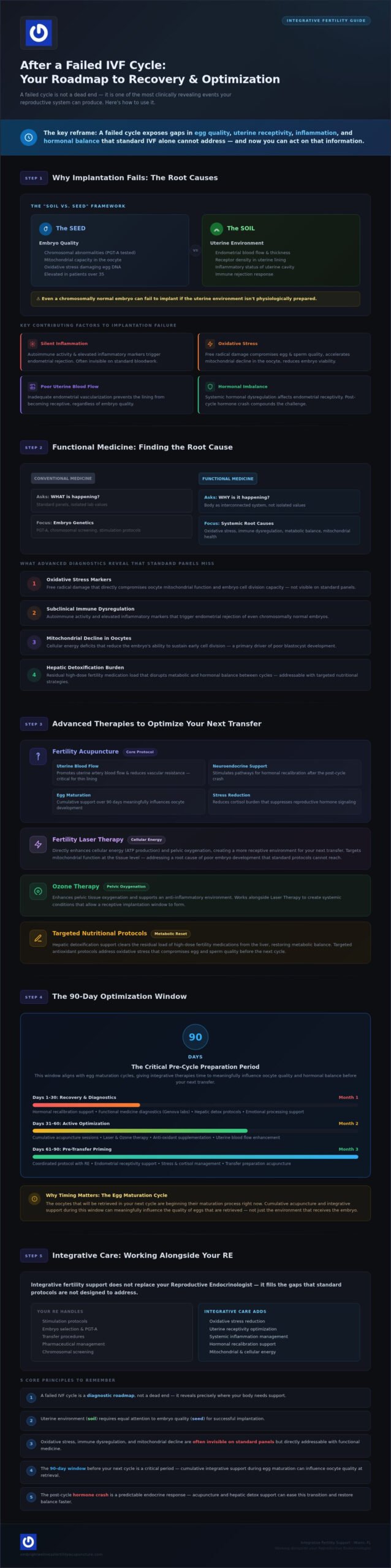
Conventional IVF consultations, particularly those focused on genetic screening, tend to center the conversation on embryo quality. Chromosomal abnormalities are a genuine and significant factor, particularly in patients over 35, and preimplantation genetic testing (PGT-A) has become a standard tool for identifying viable embryos. But here’s what that framework misses: even a chromosomally normal embryo can fail to implant if the uterine environment isn’t physiologically prepared to receive it. This is where the clinical conversation needs to expand.
Silent systemic inflammation is one of the most underappreciated contributors to implantation failure. Undiagnosed autoimmune activity, elevated inflammatory markers, or subclinical immune dysregulation can trigger a rejection response at the endometrial level, even when everything else looks optimal on paper. The body, in essence, treats the embryo as a foreign entity rather than a welcome one. These patterns don’t always appear on standard bloodwork, which is precisely why functional medicine diagnostics, including comprehensive panels like those offered through Genova labs, can surface what a routine workup might miss.
The “Soil vs. Seed” Debate in Reproductive Success
The process of in vitro fertilisation places enormous clinical attention on the embryo, the “seed,” and rightly so. But the “soil,” meaning the uterine lining and its surrounding vascular environment, deserves equal scrutiny. Endometrial thickness is routinely measured, but thickness alone doesn’t capture the full picture. Blood flow to the endometrium, the density of endometrial receptors, and the inflammatory status of the uterine cavity all influence whether implantation can occur. Acupuncture for thin uterine lining works by promoting uterine artery blood flow and reducing vascular resistance, creating a more hospitable environment at the tissue level where it matters most.
Identifying the “Hormone Crash” After Failed IVF
The abrupt discontinuation of progesterone and estrogen supplementation after a failed cycle triggers a sharp hormonal withdrawal that’s both physiological and psychological in its impact. Mood instability, profound fatigue, disrupted sleep, and a general sense of depletion are not signs of weakness; they’re predictable endocrine responses to a sudden shift in hormonal load. Clinical acupuncture can support the endocrine system during this recalibration period by stimulating neuroendocrine pathways that encourage the body’s own hormonal regulation. Alongside that, targeted nutritional strategies that support hepatic detoxification help the liver process and clear the residual load of high-dose fertility medications, restoring metabolic balance before the next cycle begins.
Functional Medicine: Finding the Root Cause of IVF Failure
Conventional medicine excels at asking what is happening. Functional medicine asks why. That distinction is everything when you’re seeking meaningful fertility support after failed IVF, because a failed cycle rarely has a single, obvious cause. It typically reflects a convergence of systemic imbalances that standard reproductive panels simply aren’t designed to detect. Functional medicine reframes the diagnostic process entirely, treating your body as an interconnected system rather than a collection of isolated lab values.
One of the most significant, and most overlooked, contributors to poor IVF outcomes is oxidative stress. Free radical damage at the cellular level directly compromises both egg and sperm quality, accelerating mitochondrial decline in the oocyte and reducing the embryo’s capacity to sustain early cell division. This isn’t a fringe concern; infertility and fertility research from the National Institutes of Health consistently identifies oxidative stress as a measurable variable in reproductive outcomes. The challenge is that standard fertility panels don’t test for it. Targeted antioxidant mapping and micronutrient analysis are required to build an accurate picture.
Gut health is another dimension that rarely enters the reproductive medicine conversation, yet its influence on hormonal balance is direct and well-documented. The estrobolome, a specific collection of gut bacteria responsible for metabolizing estrogen, plays a central role in how efficiently your body processes and eliminates excess estrogen. When gut microbiome diversity is compromised, estrogen recirculates rather than clears, creating a hormonal environment that disrupts follicular development and endometrial receptivity. Supporting gut integrity isn’t a peripheral wellness strategy; it’s a foundational step in hormonal optimization.
Thyroid and adrenal function deserve equal attention. Subclinical hypothyroidism, meaning TSH levels that fall within the “normal” range on standard panels but remain suboptimal for implantation, is a common and correctable contributor to early pregnancy loss. Chronic adrenal dysregulation elevates cortisol in patterns that suppress progesterone production, creating a physiological environment that makes sustaining early implantation significantly harder.
Advanced Diagnostics with Genova Labs
Moving beyond a standard blood draw, Genova labs fertility testing provides a cellular-level blueprint that reveals what routine panels miss: micronutrient deficiencies, heavy metal burden, environmental toxin accumulation, and markers of systemic inflammation. Heavy metals such as lead and cadmium are established endocrine disruptors, and their presence can quietly undermine hormonal signaling without producing obvious symptoms. This level of diagnostic precision transforms guesswork into a targeted, evidence-based supplementation and detoxification plan.
Peptide Therapy and Cellular Repair
Among the more innovative tools available in integrative fertility care, peptide therapy for fertility represents a compelling frontier. Specific peptides support mitochondrial function within the oocyte, which is critical because mitochondrial energy output directly governs the embryo’s capacity to develop and implant. When combined with acupuncture’s well-established ability to modulate neuroendocrine pathways, the synergy between these two approaches creates a compounding restorative effect at both the systemic and cellular levels. If you’re ready to move from unanswered questions to a precise optimization plan, exploring a functional medicine fertility consultation is a grounded, practical next step.
Advanced Supportive Therapies to Optimize Your Next Transfer
Understanding why a cycle failed is only half the work. The other half is doing something purposeful about it, and that’s precisely where advanced supportive therapies enter the picture. While functional medicine diagnostics reveal the underlying imbalances, the therapies in this section work at the cellular and vascular level to physically rebuild the conditions your reproductive system needs. This is the dimension of fertility support after failed IVF that most clinical conversations simply don’t reach.
It’s also the dimension that critics of integrative care tend to dismiss most quickly. Regulatory bodies like the HFEA have raised valid questions about evidence standards for certain add-on therapies, and those questions deserve honest engagement. What that framework often misses, however, is the distinction between isolated interventions applied without diagnostic context and a coordinated, personalized protocol built around your specific physiology. The therapies below aren’t offered as standalone promises. They’re precision tools, most effective when layered into a broader optimization plan.
Fertility Laser Therapy in Miami
Fertility Laser Therapy, grounded in the science of photobiomodulation, uses specific wavelengths of low-level light to stimulate mitochondrial activity within cells. For reproductive medicine, this matters because the oocyte is one of the most mitochondria-dense cells in the human body. When mitochondrial ATP production is compromised, the embryo’s capacity for early cell division weakens. Laser therapy applied to the ovarian and uterine regions supports cellular energy output at precisely the level where it influences egg quality and endometrial receptivity. For women over 35, whose mitochondrial efficiency naturally declines with age, this targeted cellular support is particularly relevant. As part of a pre-transfer protocol, it’s typically integrated across several sessions in the weeks preceding a frozen embryo transfer, building a cumulative restorative effect rather than a single-session intervention.
Ozone and Hyperbaric Support
Fertility ozone therapy works through a dual mechanism: it enhances pelvic oxygenation while simultaneously modulating the local immune environment. In cases where subclinical inflammation or immune dysregulation has contributed to implantation failure, ozone’s capacity to recalibrate inflammatory pathways addresses a root cause rather than a symptom. It’s a meaningful complement to the systemic immune support that functional medicine protocols provide.
Fertility hyperbaric oxygen therapy operates through a different but complementary pathway. By delivering oxygen under increased atmospheric pressure, HBOT drives oxygen into plasma and tissue at concentrations that standard circulation cannot achieve. For patients with refractory thin uterine linings, where conventional estrogen protocols have failed to produce adequate endometrial thickness, this improvement in microcirculation can be clinically significant. Both modalities are available in Miami-Dade through Ombright Wellness, making this level of advanced care accessible without requiring travel to specialized out-of-state centers.
IV Therapy for Reproductive Optimization
Fertility IV Therapy delivers high-dose antioxidants, including glutathione and vitamin C, directly into the bloodstream, bypassing the absorption limitations of oral supplementation. Given the oxidative stress burden documented in many failed IVF cases, this direct delivery method ensures that therapeutic concentrations reach the reproductive system efficiently. The IVF procedure and outcomes resource from the Mayo Clinic reinforces how complex the physiological demands of a cycle are, and IV therapy is one of the most direct ways to replenish what that process depletes. When combined with the diagnostic insights from advanced lab work, IV protocols can be formulated with genuine specificity rather than generic supplementation.
Taken together, these therapies represent a coherent approach to physical recovery and optimization, not a collection of unrelated add-ons. Each one addresses a distinct physiological gap, and each becomes more effective when it’s part of a coordinated plan built around your specific failed cycle data. That’s the standard of fertility support after failed IVF that genuinely moves the needle.
The 90-Day Prep: Timing Your Holistic Support After Failure
The waiting period between a failed cycle and the next transfer isn’t downtime. It’s the most consequential window in your entire fertility journey, and how you use it determines the physiological conditions your next embryo will encounter. Most conventional guidance treats this interval as a passive pause. Genuine fertility support after failed IVF treats it as an active, structured optimization phase with a clear biological rationale.
That rationale begins with oocyte development. Egg maturation is not a rapid event; it unfolds across approximately 90 days, during which follicles progress through developmental stages that are directly influenced by the systemic environment surrounding them. Nutritional status, inflammatory load, hormonal balance, and circulatory quality during those three months all leave a measurable imprint on the eggs that will be retrieved in your next cycle. Waiting passively is a missed opportunity. Intervening purposefully is a clinical decision.
Dietary shifts during this window deserve particular attention. A pro-gestational nutritional environment emphasizes anti-inflammatory whole foods, adequate healthy fats to support steroid hormone synthesis, and sufficient protein to sustain follicular development. Reducing refined carbohydrates stabilizes insulin signaling, which directly influences androgen balance and follicular health. These aren’t generic wellness recommendations; they’re targeted inputs into a 90-day biological process already underway.
Acupuncture Timing for Maximum Receptivity
Acupuncture’s benefits in this context are cumulative, not immediate. The pre-conception phase, spanning roughly the first six to eight weeks of the 90-day window, focuses on improving uterine artery blood flow, supporting follicle recruitment, and recalibrating the hormonal environment after the disruption of a failed cycle. As the transfer phase approaches, the clinical focus shifts toward uterine relaxation, endometrial receptivity, and immune modulation at the local uterine level. Acupuncture for IVF support in Miami at Ombright Wellness is structured to bridge both phases, maintaining continuity of support across the full preparatory arc rather than applying isolated sessions at either end.
Nervous System Regulation
Telling someone to “just relax” after a failed cycle isn’t just unhelpful; it misunderstands the physiology involved. Chronic psychological stress following reproductive loss activates the HPA axis in patterns that suppress progesterone production and elevate cortisol, creating a hormonal environment that actively works against implantation. This requires clinical intervention, not willpower.
Sound therapy for fertility works by engaging the parasympathetic nervous system through auditory stimulation, supporting vagal tone and measurably lowering cortisol over repeated sessions. Hypnotherapy addresses a layer that most protocols ignore entirely: the psychological trauma of a failed cycle. Unprocessed grief, anticipatory anxiety, and the body’s learned association between fertility treatment and loss can create a persistent stress response that no supplement protocol can fully counteract. Hypnotherapy provides a structured, evidence-informed pathway through that emotional terrain, allowing the nervous system to genuinely reset rather than simply suppress its distress.
Together, these modalities don’t compete with your medical protocol. They create the internal conditions that make your medical protocol more effective. Explore a personalized 90-day preparation plan designed to work alongside your Reproductive Endocrinologist’s timeline.
Your Path Forward with Ombright Wellness in Miami
A failed cycle leaves you with questions that deserve real answers, not a generic follow-up appointment and a revised protocol that looks almost identical to the last one. Fertility support after failed IVF, done well, begins with a thorough review of your specific history: your stimulation response, your embryo quality data, your lining measurements, and the systemic patterns that your standard workup may not have examined. That review is where Ombright Wellness starts.
Personalized fertility wellness programs at Ombright are built around your cycle data, not a generalized template. Every recommendation, whether that’s targeted acupuncture sequencing, advanced diagnostics through Genova labs, or a layered protocol incorporating ozone, laser, or IV therapy, is mapped directly to what your body’s history reveals. The goal is a unified care plan that works alongside your Reproductive Endocrinologist, not in parallel to them. Coordination with your RE is a standard part of the process, so that your integrative support and your medical protocol are genuinely aligned rather than operating in separate silos.
For patients whose schedules or locations make in-person consultations difficult, telehealth options are available for functional medicine reviews and lab interpretation. Miami professionals balancing demanding careers with fertility treatment cycles can access an initial consultation, review Genova lab findings, and begin building a personalized optimization plan without requiring time away from work for every appointment.
Miami-Based Clinical Excellence
Ombright Wellness serves patients across Coral Gables, Kendall, Coconut Grove, and the broader Greater Miami area, with a location that provides straightforward access from both Brickell and South Beach. Your initial holistic fertility assessment covers your complete reproductive history, prior cycle data, current hormonal patterns, lifestyle factors, and any systemic concerns that may not have been addressed in your standard fertility workup. You leave with a clear picture of where the gaps are and a structured plan to address them.
Next Steps to Reclaim Your Journey
Booking a consultation is straightforward. To make the most of your first session, bring the following:
- Your most recent IVF cycle summary, including stimulation protocol and embryo grading
- Any prior bloodwork, including hormone panels and thyroid results
- A list of current supplements and medications
- Any notes from your RE regarding the likely cause of the failed transfer
The more context you bring, the more precise your initial plan will be. This is fertility support after failed IVF built around your data, not a generalized starting point. Schedule your fertility optimization consultation today and take the first purposeful step toward your next cycle.
Transforming a Setback into a Strategic Roadmap
Moving forward after a failed cycle requires more than just resilience; it requires a precise understanding of your unique physiological landscape. By integrating Traditional Chinese Medicine with advanced functional lab testing, you can address the hidden variables, such as oxidative stress or subclinical inflammation, that standard protocols often overlook. Whether you’re optimizing mitochondrial health through laser therapy or modulating the immune environment with ozone, every step you take during this 90-day window builds a stronger foundation for the next transfer.
Seeking specialized fertility support after failed IVF ensures you aren’t just trying again, but trying differently with a data-driven plan. Expert care for complex reproductive journeys means nurturing the whole person, ensuring your nervous system and cellular health are in harmony before your next medical intervention begins. This integrative approach transforms a period of waiting into a period of profound preparation and systemic recovery.
Book Your Post-IVF Optimization Consultation in Miami to begin your personalized journey toward success. You’ve already shown incredible strength, and we’re here to provide the clinical expertise and steady partnership you deserve for the path ahead.
Frequently Asked Questions About Fertility Support After Failed IVF
How long should I wait after a failed IVF cycle before trying again?
Most Reproductive Endocrinologists recommend waiting at least one full menstrual cycle before a frozen embryo transfer, though the right timeline depends on your specific protocol, lining recovery, and emotional readiness. From an integrative standpoint, the more meaningful question isn’t how soon you can try again, but how purposefully you use the interval. A 90-day preparation window aligns with the natural timeline of follicular development and gives the body adequate time to recover and genuinely optimize.
Can acupuncture really improve egg quality for my next round?
Acupuncture doesn’t directly alter the genetic material within an egg, but it does influence the systemic environment surrounding follicular development. By improving uterine artery blood flow, supporting hormonal regulation, and reducing inflammatory load over a sustained course of treatment, acupuncture creates measurably better conditions during the 90-day window when follicles are maturing. Its benefits are cumulative, which is why consistent sessions across the full preparatory period produce more meaningful results than isolated pre-transfer appointments.
What is the “hormone crash” after IVF, and how can I manage it?
The hormone crash refers to the sharp physiological withdrawal that follows the abrupt discontinuation of progesterone and estrogen supplementation after a failed cycle. Fatigue, mood instability, disrupted sleep, and a general sense of depletion are predictable endocrine responses, not signs of weakness. Clinical acupuncture can support the body’s own hormonal recalibration by stimulating neuroendocrine pathways, while targeted nutritional strategies help the liver process and clear the residual load of high-dose fertility medications more efficiently.
Is there a specific diet that helps with implantation after failure?
A pro-gestational nutritional approach emphasizes anti-inflammatory whole foods, healthy fats to support steroid hormone synthesis, and adequate protein for follicular development. Reducing refined carbohydrates is particularly relevant because stable insulin signaling directly influences androgen balance and endometrial receptivity. These aren’t generic wellness recommendations; they’re targeted inputs that interact with your hormonal environment in measurable ways. A functional medicine consultation can help tailor these principles to your specific lab findings and metabolic patterns rather than applying a one-size-fits-all template.
How does laser therapy help if my embryos are already PGT-A tested?
PGT-A confirms chromosomal viability, but it doesn’t address the uterine environment receiving the embryo. Fertility Laser Therapy works through photobiomodulation, stimulating mitochondrial ATP production in the cells of the endometrium and surrounding tissue. A chromosomally normal embryo still requires a physiologically receptive uterine environment with adequate blood flow, cellular energy, and reduced local inflammation to implant successfully. Laser therapy targets precisely those conditions, making it a relevant addition to protocols even when embryo quality has already been confirmed.
Can functional medicine identify why my embryos didn’t implant?
Functional medicine can surface contributing factors that standard reproductive panels routinely miss. Advanced diagnostics through Genova labs can identify micronutrient deficiencies, heavy metal burden, markers of systemic inflammation, and gut microbiome patterns that affect estrogen metabolism. Subclinical thyroid dysfunction and adrenal dysregulation are also common, correctable contributors that fall outside the scope of a typical fertility workup. While no diagnostic tool can guarantee a definitive single cause, this level of comprehensive fertility support after failed IVF transforms guesswork into a targeted, evidence-based optimization plan.
Do you offer remote consultations if I don’t live in Miami?
Yes. Telehealth consultations are available for functional medicine reviews and Genova lab interpretation, making it possible to build a personalized optimization plan without requiring in-person attendance for every appointment. This is particularly practical for patients who are coordinating care with a Reproductive Endocrinologist in another city or whose schedules make frequent clinic visits difficult. Therapies such as acupuncture, ozone, laser, and hyperbaric oxygen do require in-person sessions at the Miami location for patients who wish to access them.
What is the success rate of integrative support after multiple failed cycles?
Honest answer: there’s no universal success rate to cite, because outcomes depend on age, diagnosis, embryo quality, and the specific imbalances identified through comprehensive assessment. What integrative support does reliably accomplish is addressing the systemic gaps that standard protocols leave unexamined, including oxidative stress, immune dysregulation, and poor endometrial receptivity. Patients with multiple failed cycles often haven’t had those variables investigated at all. A personalized plan built around your specific history gives your next cycle a meaningfully different physiological foundation to work from.