
Could a functional medicine approach to endometriosis Kendall residents are exploring complement gynecologic care rather than compete with it? Persistent pelvic pain, painful periods, or uncertainty about next steps can make it hard to sort practical support from broad wellness claims.
It’s reasonable to want a fuller picture of your health while staying connected to medical care. Functional medicine examines health history, lifestyle, and other personal factors to help shape supportive care. It can’t diagnose or cure endometriosis, and it shouldn’t replace evaluation or treatment from a gynecologist.
This article explains where individualized support may fit, what its limits are, and how to discuss complementary options with your clinicians. Ombright Wellness Fertility Acupuncture offers functional medicine, Genova lab testing, fertility acupuncture, and telehealth consultations for reproductive wellness. Fertility acupuncture is provided by an NCCAOM-Certified Diplomate of Acupuncture. These services can support a conversation about your goals alongside your existing care.
Key Takeaways
- Learn how symptom patterns and clinical evaluation inform an endometriosis diagnosis, and why symptoms alone don’t confirm the condition.
- See how a functional medicine approach to endometriosis Kendall residents are considering can explore personal health context as supportive care, without promising a cure.
- Understand how gynecologic diagnosis and treatment differ from integrative support, and how these roles can work alongside one another.
- Prepare for a productive conversation by organizing your symptom history, medical records, goals, medications, and supplements.
- Explore how functional medicine, Genova lab testing, and fertility acupuncture may fit into an individualized plan coordinated with your clinicians.
Endometriosis in Kendall: symptoms, diagnosis, and where supportive care fits
Endometriosis is a condition in which tissue similar to the lining of the uterus grows outside the uterus. A clinician may suspect it based on symptoms and clinical assessment, but symptoms alone can’t confirm it. For a general overview of possible symptoms and diagnosis, see Endometriosis on Wikipedia. A gynecology clinician can evaluate symptoms and discuss appropriate next steps.
What symptoms may lead someone to seek an endometriosis evaluation?
People may report painful periods, ongoing pelvic pain, or pain during sex. Some also experience pain with bowel movements or urination, particularly around menstruation. Symptoms vary: one person may have severe pain, while another may notice different concerns. These patterns can overlap with other conditions, so they’re useful details to share with a clinician, not proof of endometriosis.
If symptoms persist, disrupt daily activities, or cause concern, discuss them with a qualified clinician. A brief symptom record can make that conversation more specific. Note when discomfort occurs, how it relates to your cycle, where you feel it, and how it affects sleep, work, or movement. You don’t need to wait for a particular symptom pattern before raising your concerns.
Why supportive care should begin with a clear medical picture
Diagnosis and treatment decisions belong with a gynecology clinician. The American College of Obstetricians and Gynecologists’ March 2026 guidance states that a clinical assessment based on medical history, symptoms, and physical examination can support starting treatment; laparoscopy with biopsy remains the method for histologic confirmation. Your clinician can explain which evaluations and options fit your situation.
Wellness assessment has a different role. It can explore health context and supportive goals, but it can’t confirm or rule out endometriosis. Keeping your gynecologist’s findings, care plan, and guidance in view helps complementary support fit around clinical care.
For people seeking a functional medicine approach to endometriosis Kendall, this distinction offers a grounded starting point. Ombright Wellness provides functional medicine and reproductive wellness support that can be discussed alongside gynecologic care, with attention to your individual circumstances. The goal is to explore supportive care, not to promise an endometriosis diagnosis or outcome. Bring relevant medical records and a current list of medications and supplements so your existing care remains part of the discussion.
How a functional medicine approach to endometriosis in Kendall explores the whole health picture
Functional medicine is a health-care approach that seeks to identify and address the root causes of disease by examining genetics, environment, and lifestyle. In endometriosis care, that framework can guide questions about a person’s broader health context. It doesn’t mean these factors are established causes of endometriosis, or that changing them will remove lesions. The aim is to identify relevant areas for supportive care, not to prescribe a single protocol for everyone.
A functional medicine assessment can inform supportive care, but it cannot diagnose endometriosis or replace gynecologic treatment. That distinction helps set realistic expectations. What you discuss depends on your history, priorities, and current care, and no particular outcome can be guaranteed.
What an individualized assessment may consider
A conversation may cover your health history, symptom patterns, daily routines, reproductive health goals, and what you’ve already tried. Existing evaluations and clinician recommendations also help put new questions into context. Rather than assuming everyone needs the same intervention, an individualized assessment considers which areas are relevant and which are outside its role.
Testing is most useful when it has a clear purpose and suits your circumstances. Ombright Wellness offers Genova lab testing as part of fertility support. Results should be interpreted in context; they aren’t, on their own, a test to confirm or rule out endometriosis. Before testing, clarify what question it is intended to address and what the result can and cannot tell you. A lab result is one piece of information, not a substitute for clinical assessment or a reason to change prescribed care without discussing it with the treating clinician.
How lifestyle and reproductive health context fit together
Sleep, stress, nutrition, and general health may come up in a supportive-care conversation because they shape day-to-day experience and health needs. Discussing them doesn’t establish that they caused endometriosis or that lifestyle changes can reverse the condition. The purpose is to identify practical, individual areas to consider without assigning blame or promising symptom relief.
For someone exploring a functional medicine approach to endometriosis Kendall care, useful questions are specific: What is the goal of an assessment? How might a proposed step fit with current gynecologic care? What will a test result clarify, and what can’t it tell you? These questions help distinguish reasonable support from claims that go beyond what an assessment can establish.
At Ombright Wellness, functional medicine and reproductive health support can be discussed in relation to your circumstances and existing clinical care. If you’re considering this support in Kendall, explore individualized functional medicine support as a starting point for a coordinated conversation.
Functional medicine and gynecologic care: comparing roles without choosing sides
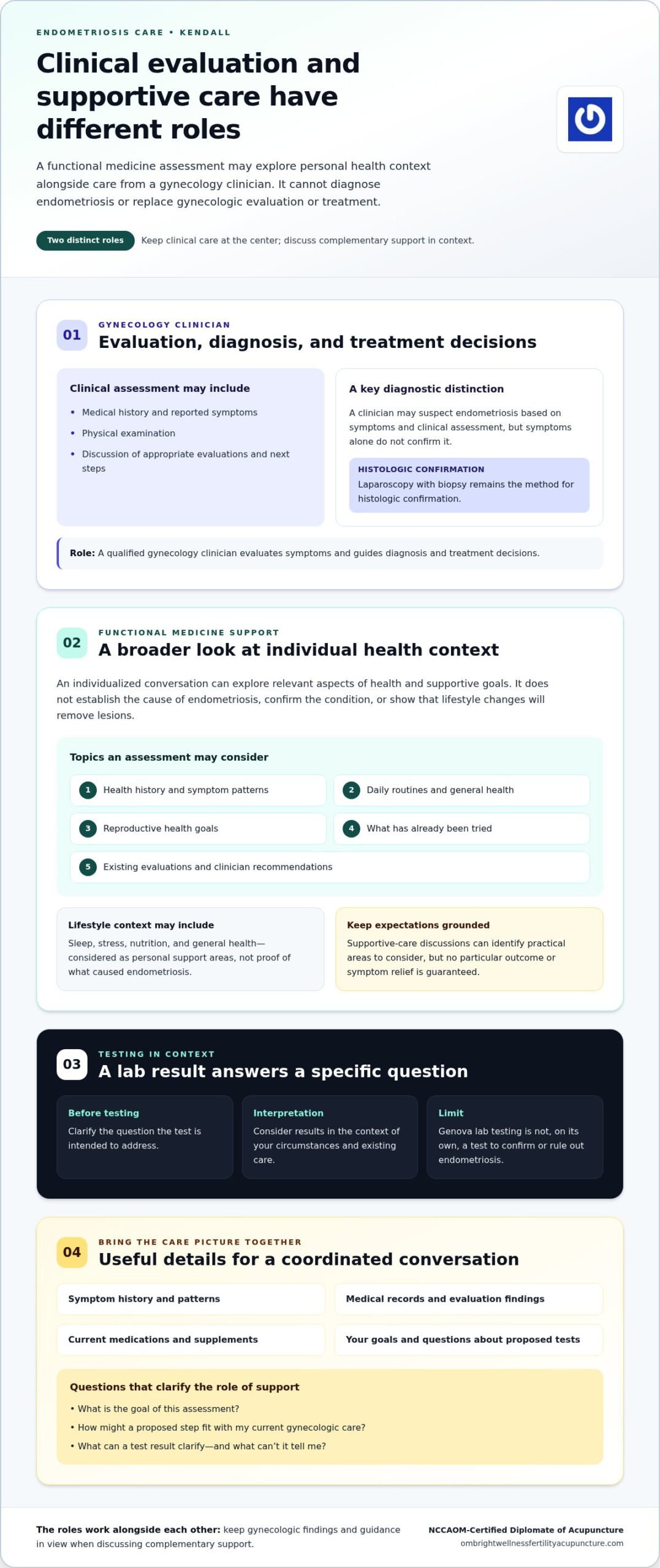
Choosing integrative support doesn’t mean stepping away from gynecologic care. The approaches have different roles: a gynecology clinician evaluates possible endometriosis and guides medical treatment, while functional medicine may explore personal health context and supportive-care priorities. Clear communication can help coordinate these roles rather than treat them as competing choices.
What gynecologic care and functional medicine each address
The American College of Obstetricians and Gynecologists’ Clinical Practice Guideline No. 11, issued in March 2026, addresses clinical assessment and medical management of endometriosis. This guidance helps frame diagnosis and treatment decisions as part of gynecologic care. Integrative support has a separate purpose: it can help a person consider wellness goals in light of their history and existing care. It doesn’t independently establish whether endometriosis is present.
The difference between these roles can be summarized simply:
- Clinical diagnosis: A gynecology clinician evaluates symptoms and relevant findings to assess suspected endometriosis.
- Medical treatment: A qualified clinician discusses and manages medical options based on the person’s clinical situation.
- Integrative support: Functional medicine may explore health context and supportive priorities alongside clinical care; it doesn’t diagnose or replace treatment.
This comparison also helps separate different kinds of claims. Clinical guidance concerns evaluation and medical care. A proposed explanation about how a lifestyle factor or biological pathway might relate to symptoms isn’t automatically an established treatment. Individual wellness goals, such as improving sleep routines or finding ways to manage stress, can be worthwhile to discuss without presenting them as ways to treat endometriosis itself.
Can integrative support cure endometriosis?
No. Integrative support should not be presented as a cure or a way to reverse endometriosis. A person may pursue support for general well-being, but that is distinct from treating the condition. Be cautious of claims that promise disease reversal, prescribe a universal protocol, or suggest that medical care is unnecessary.
For readers considering a functional medicine approach to endometriosis Kendall care, coordination matters in practical ways. Share relevant recommendations and changes with the clinicians involved in your care. Discuss any proposed change to prescribed treatment with the clinician who manages it. This helps keep supportive choices aligned with your medical plan and gives each practitioner a clearer picture of what you’re doing.
Ombright Wellness offers functional medicine and reproductive health support as parts of individualized care. If you’re exploring supportive options, functional medicine and reproductive wellness support can be a starting point for a coordinated conversation.
Preparing for an endometriosis-focused functional medicine conversation in Kendall
A little preparation can make an appointment more focused, especially when symptoms, past evaluations, and treatment decisions have accumulated over time. You don’t need to arrive with a diagnosis or a complete explanation. Share what you’ve experienced, clarify what you hope to address, and discuss how supportive care would fit with your current clinical plan.
Use this checklist to organize the conversation:
- Summarize your symptoms. Note when they began, how they change across your menstrual cycle, where you feel discomfort, and how symptoms affect daily activities. Describe what you’ve noticed rather than trying to diagnose yourself.
- Gather relevant records. Bring available test results, imaging or procedure reports, and a brief history of treatments you’ve tried and how they affected you. Include your gynecology clinician’s recommendations and the names of other members of your care team.
- List current medications and supplements. Include prescribed medicines, over-the-counter products, and supplements, with directions if available. This gives the practitioner context and supports discussion of possible interactions or care coordination.
- Define your goals and follow-up questions. Consider what you want help with, such as understanding your overall health context or identifying practical wellness priorities. Share fertility goals if they’re relevant to your care, and ask how progress will be reviewed.
Bring questions, too. You might ask: What is the purpose and scope of this assessment? What evidence supports a proposed recommendation, and what remains uncertain? If testing is suggested, how could the result inform a decision, and what can it not establish? These questions help set realistic expectations and distinguish information gathering from diagnosis or treatment.
Coordination is part of preparation. If you’re comfortable doing so, discuss the supportive-care plan with your gynecology clinician, especially before changing prescribed treatment. You can also ask how information from the functional medicine discussion may be shared or considered alongside your existing care. This keeps your priorities visible without asking one approach to do the work of another.
For people considering a functional medicine approach to endometriosis Kendall residents can explore, a written summary can help focus an in-person or telehealth conversation. Keep it brief: symptoms, records, current care, goals, and questions. You can add details during the discussion.
If you have sudden, severe, or rapidly worsening symptoms, seek appropriate medical care promptly rather than waiting for a wellness appointment. For a non-urgent discussion of individualized reproductive wellness support, connect with Ombright Wellness.
Exploring Ombright Wellness functional medicine support in Kendall
For someone seeking reproductive wellness support in Kendall, Ombright Wellness offers functional medicine to discuss health context and supportive priorities. This care can sit alongside gynecologic evaluation and treatment. It isn’t a way to diagnose, cure, or reverse endometriosis, and any plan should reflect your circumstances and existing clinical guidance.
What an integrative support plan may include
A functional medicine conversation may cover health history, current concerns, lifestyle, and reproductive health goals. Ombright Wellness offers Genova lab testing as part of fertility support. Testing doesn’t independently diagnose endometriosis. Results can provide information to interpret in context alongside your clinical picture.
Fertility acupuncture is also available as supportive care. Fertility acupuncture is a specialized form of acupuncture that targets reproductive organs to improve blood flow, hormone balance, and stress reduction. It isn’t a substitute for gynecologic diagnosis or medical treatment, and no endometriosis outcome should be assumed. At Ombright Wellness, acupuncture care is provided by an NCCAOM-Certified Diplomate of Acupuncture.
The appropriate goals and services depend on individual context. One person may want to discuss general wellness priorities; another may be exploring reproductive health support. A thoughtful plan should make clear what each component is intended to address, how it fits with ongoing medical care, and what it cannot establish or promise.
Local and remote ways to explore support
People in Kendall can explore reproductive wellness support through Ombright Wellness, including telehealth consultations. A remote conversation offers a way to discuss health history, priorities, and questions. Whether meeting remotely or seeking local support, having current records and clinician guidance available can help connect the discussion to existing care.
If you’re considering the functional medicine approach to endometriosis Kendall readers may explore, start by identifying what you hope to understand or support. You might want to discuss how functional medicine, relevant testing, or fertility acupuncture could fit alongside your gynecologist’s care. These are supportive-care conversations, not promises of treatment for endometriosis.
Ombright Wellness welcomes readers who want to learn more about individualized reproductive wellness support. Explore the services or contact the clinic to discuss your goals and how supportive care may fit with your existing medical plan.
Take a thoughtful next step for your care
You don’t have to resolve every question at once. Choose one priority for your next conversation, whether that’s understanding your options, clarifying a wellness goal, or making sure everyone involved in your care has the same information. A clear focus can help you move forward without expecting one approach to answer every concern.
If you’re exploring a functional medicine approach to endometriosis Kendall care, keep your gynecology clinician’s guidance central as you consider complementary support. Take time to reflect on what feels relevant, what questions remain, and what kind of support would feel meaningful to you.
Ombright Wellness offers reproductive wellness support, including functional medicine, Genova labs and diagnostics, fertility acupuncture with an NCCAOM-Certified Diplomate of Acupuncture, and telehealth consultations. These options can be explored as supportive care, not as a replacement for endometriosis diagnosis or treatment. Explore supportive fertility and wellness care with Ombright Wellness when you’re ready to consider a next step.
Your care can move forward one informed conversation at a time.
Frequently Asked Questions
Can functional medicine cure endometriosis?
No. Functional medicine should not be presented as a cure or a way to remove endometriosis lesions. It may help someone explore general wellness priorities, such as sleep or nutrition, but those discussions are distinct from medical treatment of the condition. If you’re considering a new wellness practice or supplement, discuss it with your treating clinician, especially if you’re already following a treatment plan or managing other health concerns.
Is functional medicine a replacement for gynecologic care for endometriosis?
No. A gynecology clinician is the appropriate person to evaluate suspected endometriosis and guide medical treatment decisions. Functional medicine may offer a separate space to discuss personal health context and supportive goals, but it can’t confirm or rule out the condition. Keeping your gynecologist informed about complementary care can help align the different parts of your plan and reduce the risk of conflicting recommendations.
How is endometriosis diagnosed?
A qualified clinician evaluates symptoms and medical history, and may perform a physical examination or recommend imaging. The American College of Obstetricians and Gynecologists’ March 2026 guidance says a clinical diagnosis can support starting treatment; laparoscopy with biopsy remains the method for histologic confirmation. Your clinician can explain which evaluations are appropriate for you. Blood biomarkers such as CA-125 aren’t recommended by ACOG as a diagnostic test for endometriosis.
Can functional medicine and conventional endometriosis treatment be used together?
Yes, supportive functional medicine care can be considered alongside medical treatment when the approaches are coordinated. Share your current treatment plan, medications, and supplements with the practitioners involved, and tell your gynecology clinician about complementary services you’re considering. For Kendall residents exploring a functional medicine approach to endometriosis Kendall support, discuss any change to prescribed treatment with the clinician managing it rather than making changes based on wellness advice alone.
What happens during a functional medicine consultation for endometriosis?
A consultation may involve discussing your health history, current concerns, daily routines, priorities, and existing care. Bring a symptom timeline, relevant records, and a list of medications or supplements to make the conversation specific. The practitioner may discuss whether further assessment or testing could be useful, but the discussion doesn’t follow a guaranteed protocol and doesn’t establish an endometriosis diagnosis.
Can lab testing identify the cause of endometriosis?
No lab test should be treated as a stand-alone way to identify or confirm endometriosis. Testing may provide information about other aspects of health when there’s a clear reason to consider it, but results need to be interpreted in context and don’t replace gynecologic evaluation. Before proceeding with a test, ask what question it is intended to address, how results could inform care, and what conclusions they cannot support.
Does Ombright Wellness offer remote functional medicine consultations for Kendall patients?
Yes. Ombright Wellness Fertility Acupuncture offers remote telehealth consultations as part of its reproductive wellness support. People in Kendall, Coral Gable, Cutler Bay, Homestead, Pincrest, Miami, Coconut Grove, South Beach, Brickel, and Key West can use a consultation to discuss their health history and goals. Telehealth support is complementary and doesn’t replace an in-person medical evaluation or gynecologic treatment when those are needed.