
Could hyperbaric oxygen therapy improve sperm quality, or does a promising theory still need stronger clinical proof? If you’re researching hyperbaric oxygen for sperm quality Pincrest, it’s reasonable to want clear answers before adding a therapy to an already personal fertility journey. A 2025 meta-analysis in Medical Gas Research reported improvements in several sperm measures across nine randomized trials. However, the evidence remains emerging, and the results do not guarantee an individual benefit.
It can be difficult to separate a biological rationale, including oxygen delivery and oxidative stress, from outcomes shown consistently in people. This guide explains what common semen-analysis measures can tell you, how to assess the research, and what safety and suitability questions to raise with your fertility clinician. It also explains why hyperbaric oxygen for fertility is an off-label application, rather than an established treatment for male infertility, and how supportive care may fit alongside semen testing and your existing care plan. The aim is an informed, individualized next step, not a promise of results.
Key Takeaways
- Learn what semen-analysis measures can and can’t tell you, and why a fertility clinician should interpret the results in context.
- Assess hyperbaric oxygen for sperm quality Pincrest with realistic expectations and specific questions about the evidence.
- Compare supportive therapies with standard male-fertility evaluation before deciding what may fit your care plan.
- Ask how safety, personal health history, and progress would be assessed before considering therapy.
- Discuss fertility hyperbaric oxygen therapy with Ombright Wellness and ask how it may coordinate with existing fertility care.
Hyperbaric Oxygen for Sperm Quality in Pincrest: What Is Being Considered?
If you’re considering hyperbaric oxygen for sperm quality Pincrest, start by separating a possible biological explanation from evidence of improved semen results or fertility outcomes. Hyperbaric oxygen therapy is a medical treatment in which a person breathes oxygen in a pressurized environment. For a neutral overview of the therapy and its established medical uses, see Hyperbaric medicine.
Sperm quality is not a single score. A semen analysis measures several characteristics, each of which offers different information. It can help a clinician identify patterns, but it cannot explain every fertility concern or predict whether conception will occur.
Which sperm-quality measures are commonly assessed?
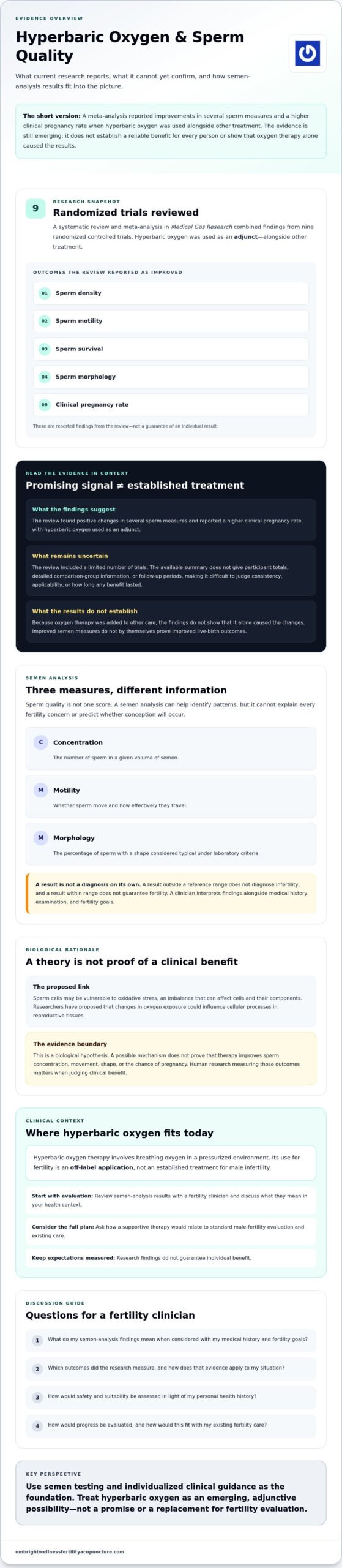
Concentration refers to the number of sperm in a given volume of semen. Motility describes whether sperm move and how effectively they travel. Morphology measures the percentage of sperm with a shape considered typical under laboratory criteria. A result outside a reference range is not a diagnosis by itself, and a result within range does not guarantee fertility. A clinician interprets the findings alongside medical history, examination, and the fertility goals of the patient or couple.
Why might someone ask about oxygen therapy and sperm?
Sperm cells may be vulnerable to oxidative stress, an imbalance that can affect cells and their components. One proposed rationale for hyperbaric oxygen is that changes in oxygen exposure could influence cellular processes in reproductive tissues. That possibility is a hypothesis, not proof that treatment improves sperm concentration, movement, shape, or the chance of pregnancy.
A biological mechanism can help researchers frame a question, but it does not establish that a therapy produces a reliable clinical benefit. Claims about sperm outcomes should be judged by human research that measures those outcomes, not by theory alone. Review the evidence and its limitations before deciding whether the therapy belongs in an individualized care plan.
For patients in Pincrest, a practical starting point is to review semen-analysis results with a fertility clinician. Ask what the findings mean for your situation and how a supportive therapy would relate to them. This keeps the discussion focused on your health context, rather than a general promise about oxygen or sperm.
What Does Research Say About Hyperbaric Oxygen and Sperm Quality?
The human evidence is worth examining, but it is not strong enough to treat hyperbaric oxygen as an established way to improve fertility. A 2025 systematic review and meta-analysis by Liu and colleagues, published in Medical Gas Research, combined findings from nine randomized controlled trials. It reported that hyperbaric oxygen used as an adjunct was associated with improvements in sperm density, motility, survival, and morphology, as well as a higher clinical pregnancy rate.
Those findings deserve attention, but context matters. The review included a limited number of trials, and the research summary available here does not provide participant totals, detailed comparison-group information, or follow-up periods. Without those details, it is difficult to judge how consistent the results were, which patients they may apply to, or whether benefits lasted. A change in semen measures also does not by itself establish an improvement in live-birth outcomes.
Which outcomes matter when judging the evidence?
Check what a study actually measured. Semen parameters such as concentration, movement, and morphology are not the same as clinical pregnancy or live birth. Consider whether treatment was compared with a control group, whether it was added to other care, and how long participants were followed. Findings from people treated for unrelated conditions, or from laboratory and animal studies, cannot establish a fertility benefit in men.
Human clinical evidence: The 2025 review reports outcomes from randomized trials in which hyperbaric oxygen was used alongside other treatment. Because it was an adjunct, the reported results do not show that oxygen therapy alone caused the changes. The summary does not identify enough about the trial populations or co-treatments to determine whether the findings apply to a particular diagnosis or patient.
Laboratory and animal research: These forms of research can help investigate how oxygen exposure or oxidative stress might affect cells and reproductive processes. They are not equivalent to clinical trials in people. No specific laboratory or animal findings are detailed in the research information summarized here, so they should not be used to support a claim about human fertility outcomes.
What cannot be concluded from a biological explanation?
A proposed mechanism, such as a possible effect on oxidative stress, helps explain why researchers may study a therapy. It does not prove that the therapy improves semen results, conception, or live birth. Citation-ready summary: A 2025 meta-analysis of nine randomized trials reported improved sperm parameters and clinical pregnancy rates when hyperbaric oxygen was used as an adjunct, but the limited trial base does not establish a dependable fertility benefit or a live-birth benefit.
For readers researching hyperbaric oxygen for sperm quality Pincrest, the careful next step is to weigh this evidence with a fertility clinician, not to substitute therapy for evaluation or recommended care. Ombright Wellness lists fertility hyperbaric oxygen therapy as part of its offerings. A discussion can help clarify goals and coordination with existing fertility care.
How Does Hyperbaric Oxygen Compare With Standard Male-Fertility Evaluation?
Hyperbaric oxygen is a supportive therapy under investigation for fertility, not a diagnostic test. A semen analysis and review with an appropriate clinician offer a grounded starting point. They can identify findings that may need further evaluation and help guide a care plan based on individual circumstances. If fertility concerns persist, do not postpone an assessment while considering an add-on therapy.
| Care category | Purpose | How it fits |
|---|---|---|
| Diagnostic evaluation | Reviews semen parameters and relevant medical history to assess possible factors affecting fertility. | Helps a clinician decide whether repeat testing or further assessment is appropriate. |
| Established care | Addresses findings or diagnoses identified through clinical evaluation. | A fertility specialist or urologist can explain relevant options and how they relate to your goals. |
| Supportive therapies | May be discussed as additions to a broader plan. | Should not replace diagnostic evaluation or delay clinician-recommended care; evidence varies by therapy. |
What does semen analysis tell you, and what does it not tell you?
A semen analysis measures selected features, such as sperm concentration, movement, and shape. It provides useful clinical information, but it does not identify every possible cause of difficulty conceiving or determine fertility on its own. Do not treat an isolated result as a diagnosis. Ask a clinician to explain the findings in context, including whether additional assessment or testing is appropriate.
How can supportive therapies fit into a broader care plan?
Integrative services can be discussed as complementary options, with clear expectations about what is known and what remains uncertain. Tell your reproductive specialist or urologist about any therapy you are considering, and ask how it fits with your evaluation and care. For readers exploring hyperbaric oxygen for sperm quality Pincrest, coordination helps keep decisions connected to clinical findings rather than assumptions.
Acupuncture is a separate supportive-care topic with its own evidence base; it should not be treated as evidence for hyperbaric oxygen. Read about acupuncture for male fertility as a distinct option. For a broader overview of supportive fertility therapies, consider how each may complement, but not replace, clinician-led evaluation.
What Should Pincrest Patients Ask Before Considering Hyperbaric Oxygen?
A useful discussion should cover the goal of therapy, the evidence for that goal, personal safety, and how the approach would fit with ongoing fertility evaluation. If you’re considering hyperbaric oxygen for sperm quality Pincrest, bring your semen-analysis results and medical history to the conversation, and include the clinician managing your fertility care.
Questions about evidence, safety, and suitability
Ask for clear explanations rather than promises. The answers should help you understand what is known, what remains uncertain, and how the provider will assess whether the approach may be appropriate for you.
- What specific goal are we considering? Ask whether the intended outcome relates to semen-analysis measures, another concern, or general supportive care.
- What human evidence supports that goal? Ask which studies apply to people with a similar fertility concern, and whether they measured semen parameters, pregnancy, or live birth.
- How would progress be assessed? Clarify which outcomes would be monitored, who would review them, and how results would inform next steps.
- What screening, risks, or contraindications apply to me? Share relevant health conditions, medications, and medical history, then ask whether any could affect your suitability.
- How do you explain the uncertainties? Ask what benefits are not established and confirm that no outcome is being guaranteed.
Questions about coordinating care near Pincrest
Confirm local details rather than assuming them. Ask where visits take place, whether the service is currently available to you, and how the provider can coordinate with the clinician overseeing your fertility evaluation. Clarify which records or test results would be useful and what you may need to arrange with your care team.
- How will this fit with my current care? Ask whether considering therapy could affect the timing of testing or other clinician-recommended steps.
- Who should I contact if my evaluation changes? Agree on how new results or concerns will be shared with the relevant care providers.
Checklist: Before treatment, ask what evidence supports your goal, what risks and screening apply to you, how progress will be assessed, and how care will coordinate with your fertility clinician.
Questions about the uterine lining differ from questions about sperm outcomes. The information on hyperbaric oxygen therapy and uterine lining addresses that separate topic. To discuss fertility hyperbaric oxygen therapy as part of individualized care, contact Ombright Wellness about your care goals.
Discussing Fertility Hyperbaric Oxygen Therapy With Ombright Wellness
Ombright Wellness Fertility Acupuncture lists fertility hyperbaric oxygen therapy among its integrative reproductive wellness services. For Pincrest-area patients considering this option, a conversation can help clarify personal goals, relevant health history, and how supportive care may fit alongside an existing fertility evaluation. It should not be treated as a promise that sperm quality, conception, or pregnancy outcomes will improve.
The practice also identifies an NCCAOM-Certified Diplomate of Acupuncture. That credential is relevant to its acupuncture care, not evidence of a specific hyperbaric oxygen outcome. If you’re exploring hyperbaric oxygen for sperm quality Pincrest, ask what the service includes, what evidence applies to your goal, and how the practice coordinates with your fertility clinician.
What to share during an initial conversation
Bring recent semen-analysis results, if available, and note questions from your fertility evaluation. Share relevant diagnoses, medications, medical history, and any clinician-directed treatments you’re receiving or considering. This context can inform a discussion about suitability, but only an individual assessment can address your circumstances.
Ask how the provider distinguishes supportive wellness care from the fertility evaluation and treatment managed by your reproductive specialist or urologist. If a clinician has recommended follow-up testing or another next step, ask how to keep that care on track while you consider an additional therapy.
A measured next step for local patients
Confirm whether fertility hyperbaric oxygen therapy is available to you and where visits take place. The practice lists services in the Miami area, including Pinecrest in its materials, but current availability and visit details are best confirmed directly. Ask how information from your semen analysis and fertility care team can inform the discussion, and whether you should obtain guidance from the clinician managing your evaluation before making a decision.
Ombright Wellness Fertility Acupuncture serves patients in Coral Gables, Kendall, Cutler Bay, Homestead, Pincrest, Miami, Coconut Grove, South Beach, Brickell, and Key West. A consultation does not need to result in a commitment. It can be an opportunity to review your questions, understand what is and is not known, and decide whether further discussion is appropriate. Contact Ombright Wellness Fertility Acupuncture to discuss your fertility care and ask whether a conversation about fertility hyperbaric oxygen therapy may be a suitable next step.
Make Your Next Fertility-Care Step Informed and Individual
Hyperbaric oxygen may be of interest as supportive fertility care, but current research does not establish it as a dependable way to improve sperm quality or fertility outcomes. Semen analysis and clinician review remain key starting points for understanding results and deciding whether further evaluation is needed. If you’re weighing hyperbaric oxygen for sperm quality Pincrest, discuss the evidence, your personal suitability, and how supportive therapy would fit with your existing care.
Ombright Wellness lists fertility hyperbaric oxygen therapy among its offerings. The practice also identifies an NCCAOM-Certified Diplomate of Acupuncture, a credential relevant to its acupuncture care. A conversation can help you clarify your goals and ask how care may coordinate with the clinician overseeing your fertility evaluation, without assuming a particular result.
Bring your questions and relevant test results, and take the time you need to consider the answers. Contact Ombright Wellness to discuss your fertility care and ask whether a consultation may be appropriate. An individualized discussion can help you decide what questions to take to your fertility care team and what next step makes sense for you.
Frequently Asked Questions
Is hyperbaric oxygen proven to improve sperm quality?
No, current evidence does not establish hyperbaric oxygen as a proven way to improve sperm quality. A proposed effect on oxygen exposure or cellular processes is a biological rationale, not proof of a clinical benefit. A 2025 meta-analysis reported promising results across nine randomized trials, but the limited trial base calls for caution. Ask your fertility clinician which findings may apply to your situation and whether any outcomes would be monitored.
Can hyperbaric oxygen therapy increase sperm count or motility?
There is no guarantee that hyperbaric oxygen will increase sperm count or motility. These are separate semen-analysis measures, and any claim of improvement should be supported by relevant human research. If your results raise questions, review them with a qualified clinician, who can explain them in context and advise whether further evaluation or follow-up testing is appropriate. Do not use a hoped-for change as a reason to delay that discussion.
How does hyperbaric oxygen therapy relate to male fertility?
Hyperbaric oxygen is being explored in relation to oxygen exposure and biological processes that may be relevant to sperm. A proposed mechanism, however, does not establish improved fertility. Sperm parameters such as movement and concentration are different outcomes from pregnancy or live birth. Before adding this supportive therapy to your care, ask your fertility clinician what human evidence is available and whether it relates to your diagnosis and goals.
Is hyperbaric oxygen therapy safe for everyone?
No, you should not assume that hyperbaric oxygen therapy is appropriate for everyone. Suitability depends on individual health history and potential risks or contraindications. Before proceeding, tell a qualified provider about your medical conditions, medications, and current treatments. Ask what screening is needed, what risks apply to you, and what alternatives may be considered. This general information cannot provide personal medical clearance or replace advice from your treating clinician.
Should I get a semen analysis before considering hyperbaric oxygen?
Discuss semen analysis with a fertility clinician or urologist before deciding whether supportive therapy belongs in your plan. The test assesses selected sperm parameters, but it does not explain every fertility concern, and an individual result should not be treated as a diagnosis by itself. A clinician can interpret findings alongside your health history and goals, then advise whether further assessment or follow-up testing is appropriate. Hyperbaric oxygen does not replace testing or indicated care.
Can hyperbaric oxygen therapy replace fertility treatment?
No, hyperbaric oxygen should not replace fertility evaluation or clinician-directed treatment. If you have concerns about conception, discuss assessment and care options with a qualified professional. Supportive therapy can be considered in context, with a clear conversation about evidence limits, personal suitability, and coordination with your existing care team. Keep your fertility specialist or urologist informed so that decisions about additional therapies do not interrupt recommended evaluation or treatment.
Can Pinecrest patients discuss fertility hyperbaric oxygen therapy with Ombright Wellness?
Ombright Wellness lists fertility hyperbaric oxygen therapy among its reproductive wellness offerings. Its materials list Pincrest, as well as Coral Gable, Kendall, Cutler Bay, Homestead, Miami, Coconut Grove, South Beach, Brickel, and Key West. Contact the practice to confirm location details and current availability. A discussion can help clarify your goals and how the therapy may fit with your fertility care team.