
Laser Therapy for Fertility: What Does the Research Say?
Trying to conceive can lead you down a long list of possible options, from lifestyle changes and acupuncture to medications, IUI, and IVF. One treatment that has attracted growing interest is laser therapy for fertility, also called low-level laser therapy (LLLT) or photobiomodulation (PBM).
But does shining low-level light on cells actually improve fertility?
The short answer is: the research is promising, but it is not yet strong enough to say that laser therapy is a proven fertility treatment for everyone.
Research has explored photobiomodulation in areas such as sperm motility, cellular energy, oxidative stress, and reproductive function. Some studies have reported encouraging findings, while others emphasize the need for larger, better-designed clinical trials before firm conclusions can be made.
That distinction matters when you are making decisions about your fertility care.
What Is Laser Therapy for Fertility?
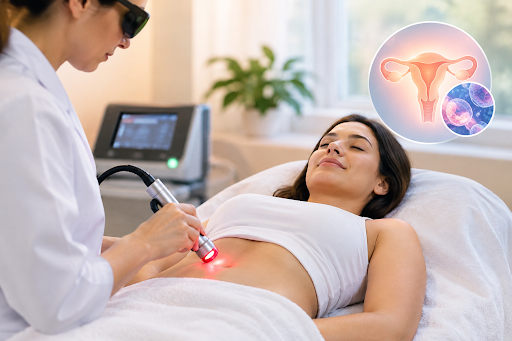
Fertility laser therapy generally refers to the use of low-intensity light, often red or near-infrared light, with the goal of influencing cellular activity. The technique is commonly discussed under the broader term photobiomodulation.
Unlike surgical lasers, low-level light therapy is intended to deliver light energy without cutting or removing tissue.
Researchers are interested in PBM because cellular processes involving mitochondria may respond to specific wavelengths and doses of light. Mitochondria are responsible for producing much of the cell’s usable energy, including ATP.
The theory is that carefully controlled light exposure may influence cellular energy production and other biological pathways.
However, the important word is may.
Different studies use different wavelengths, doses, treatment durations, devices, and treatment locations. Because of this variation, results from one study cannot automatically be applied to every laser therapy protocol.
Laser Fertility Treatment: How Does It Work?
The proposed mechanisms behind laser fertility treatment are still being investigated.
Some research suggests that photobiomodulation can affect mitochondrial activity, cellular metabolism, blood flow, and oxidative processes. In reproductive research, scientists have examined whether these effects could potentially influence sperm function or reproductive tissues.
For example, laboratory research involving human sperm has found that particular PBM protocols can increase sperm motility. A 2020 study examining human sperm samples reported improvements in motility and viability after exposure to red and near-infrared PBM.
Other research has explored the relationship between PBM and mitochondrial energy production in sperm.
This is biologically interesting because sperm movement requires energy. But laboratory findings are not the same thing as demonstrating that a treatment increases pregnancy or live-birth rates in real-world patients.
That difference is essential when interpreting the research.
What Does the Research Say About Laser Therapy for Infertility?
Research into laser therapy for infertility can broadly be divided into several areas: male fertility, female fertility, and assisted reproductive treatment.
Male Fertility and Sperm Motility
This is one of the areas where the research base is relatively interesting.
A 2023 systematic review evaluated 15 studies involving photobiomodulation and male infertility. The review included 14 in-vitro studies and one randomized clinical trial. The researchers found that the studies generally reported improvements in progressive sperm motility, but they also emphasized substantial differences in treatment parameters, populations, and study methods.
Another study found that 810-nm photobiomodulation improved progressive motility in sperm from men with asthenozoospermia, with findings suggesting an effect on mitochondrial energy metabolism.
More recent laboratory research has continued to investigate how different wavelengths influence sperm energy metabolism and oxidative stress. Results appear to depend significantly on the wavelength and dose used.
So, what does this mean?
It means there is a scientific basis for continuing to study PBM as a potential fertility-support tool, particularly for certain aspects of sperm function.
It does not mean that laser therapy has been proven to overcome every cause of male infertility or guarantee pregnancy.
Female Fertility
The evidence for female fertility is considerably less established.
A 2024 case series examined red and near-infrared photobiomodulation in three women with unexplained, age-related fertility concerns. All three cases resulted in full-term births, but the study involved only three patients and the authors specifically stated that larger studies are needed to validate the treatment protocol.
That is an encouraging signal, but a three-person case series cannot establish that PBM causes improved fertility outcomes.
Other systematic research has also noted that studies involving reproductive tissues vary substantially in their laser parameters and experimental models, making it difficult to establish a standardized treatment approach.
IVF and Implantation
Researchers have also begun studying low-level laser therapy in people undergoing assisted reproductive treatment.
For example, a randomized clinical trial investigating LLLT before IVF in patients with recurrent implantation failure reported higher biochemical and clinical pregnancy rates in the treatment group, but the differences were not statistically significant. The authors described the findings as potentially promising rather than definitive.
This is an important distinction.
If a treatment is being considered during IVF, it should be viewed as a potential complementary approach rather than a replacement for evidence-based reproductive medicine.
Benefits of Laser Therapy for Fertility: What Is Actually Supported?
When people search for the benefits of laser therapy for fertility, they may encounter claims about improved egg quality, increased implantation, better circulation, hormonal balance, and higher pregnancy rates.
Some of these ideas have biological or preliminary research behind them, but they should not all be treated as established clinical outcomes.
Based on current research, areas of interest include:
- Cellular energy and mitochondrial activity
- Sperm motility
- Cellular responses to oxidative stress
- Blood-flow-related mechanisms
- Reproductive tissue function
- Potential support during assisted reproductive treatment
However, researchers have not yet established one universally accepted PBM protocol for fertility.
The wavelength, energy dose, exposure time, treatment frequency, and treatment location may all matter.
That means the phrase “laser therapy” alone does not tell you whether two treatments are scientifically equivalent.
Laser Therapy Fertility Safety: Is It Safe?
One of the most common questions is about laser therapy fertility safety.
So, is laser therapy safe for fertility?
There is not enough evidence to give a blanket “yes” for every device, dose, treatment location, and patient.
The available research provides some reassuring findings. In the 2023 systematic review of PBM and male infertility, most studies that assessed safety reported favorable findings, although the researchers noted substantial differences between studies and cautioned against drawing overly strong conclusions.
The same review also highlights an important point: PBM effects can depend on treatment duration and energy dose. There is currently no single standardized intervention protocol that applies to all fertility situations.
For that reason, safety should be considered on an individual basis.
A qualified provider should know what device is being used, what wavelength and dose are involved, where treatment is being applied, and whether the treatment is appropriate for your particular fertility situation.
Laser Therapy Side Effects and Important Considerations
People often assume that because low-level laser therapy is non-invasive, it automatically has no risks.
That is not a good way to evaluate any treatment.
Potential laser therapy side effects and safety considerations depend on the specific technology and protocol being used. Research into PBM has generally reported few serious adverse effects in the fertility studies reviewed, but the evidence base remains limited.
Before beginning treatment, ask:
- What type of laser or light device is being used?
- What wavelength is used?
- What dose and treatment duration are recommended?
- What fertility concern is the treatment intended to address?
- Is the evidence based on human clinical trials or laboratory studies?
- How will the treatment fit with medications, IUI, IVF, or other fertility care?
- What should you do if you become pregnant during a treatment plan?
These questions can help you separate evidence-based information from broad marketing claims.
What Should You Expect From the Research?
One of the biggest challenges when researching fertility laser therapy online is distinguishing promising research from proven treatment.
For example, a laboratory study may demonstrate that light exposure changes sperm motility. That is valuable scientific information.
But it does not automatically prove that the same treatment increases live births.
Similarly, an interesting case report or small case series can provide a reason for further research, but it cannot establish effectiveness for the general population.
The strongest evidence generally comes from well-designed randomized clinical trials involving enough participants to determine whether a treatment genuinely changes meaningful outcomes.
For fertility laser therapy, more research is still needed to determine which patients may benefit, which protocols are most appropriate, and whether changes in laboratory markers translate into improved pregnancy or live-birth outcomes.
How Can Laser Therapy Fit Into an Integrative Fertility Plan?
If you are considering laser therapy, think of it as one possible component of a broader fertility plan rather than the entire solution.
Your fertility evaluation may need to consider factors such as:
- Ovulation and menstrual-cycle patterns
- Ovarian reserve
- Age-related fertility factors
- Sperm count and motility
- Tubal health
- Uterine or endometrial factors
- Previous pregnancy or implantation history
- Lifestyle and nutritional factors
- Medical conditions and medications
For some people, complementary approaches such as acupuncture may also be incorporated alongside conventional fertility treatment.
The goal is not to replace reproductive endocrinology or other appropriate medical care. Instead, complementary care can be discussed as part of a coordinated approach.
Fertility Laser Therapy in Miami: Where Does Ombright Fit In?
For individuals exploring integrative fertility care in Miami, Ombright Wellness Fertility Acupuncture offers fertility-focused services that include fertility acupuncture and fertility laser therapy. The practice describes its approach as combining holistic care with modern reproductive perspectives.
The most important step is to start with a conversation about your individual goals rather than assuming that one treatment is right for everyone.
If you are already working with a reproductive endocrinologist, OB-GYN, or fertility clinic, it is also helpful to discuss complementary treatments with your medical team. This is particularly important if you are preparing for IVF, IUI, embryo transfer, or pregnancy.
The Bottom Line: Is Laser Therapy for Fertility Worth Considering?
So, what does the research actually say about laser therapy for fertility?
The evidence is promising but preliminary.
Research has found interesting effects of photobiomodulation on sperm motility and cellular energy, while early research involving female fertility and assisted reproduction provides reasons for further investigation.
At the same time, there is not enough high-quality evidence to describe fertility laser therapy as a guaranteed way to improve egg quality, increase pregnancy rates, or overcome infertility.
If you are considering treatment, focus on informed decision-making:
- Understand what the treatment is designed to support.
- Ask what evidence exists for your specific fertility concern.
- Find out which device and protocol are being used.
- Ask about safety and possible side effects.
- Continue appropriate medical fertility evaluation and treatment.
- Discuss complementary therapies with your fertility-care team.
For someone in Miami looking for a more integrative approach, a consultation with Ombright Wellness Fertility Acupuncture can be an opportunity to discuss whether fertility laser therapy and other supportive approaches are appropriate for your individual situation.
Frequently Asked Questions
Is laser therapy proven to treat infertility?
No. Current research is promising but not conclusive. Studies have investigated photobiomodulation for sperm function, reproductive tissues, and assisted reproduction, but larger and better-designed clinical trials are needed before it can be considered a proven treatment for infertility.
Is laser therapy safe for fertility?
Available studies have generally reported reassuring safety findings, but safety depends on the specific device, wavelength, dose, treatment location, and patient. There is not one universal protocol that can be considered appropriate for everyone.
Can laser therapy improve sperm quality?
Some laboratory and clinical research suggests that photobiomodulation may improve aspects of sperm function, particularly progressive motility. However, improved sperm motility does not necessarily mean that pregnancy or live-birth rates will increase.
Can women use low-level laser therapy for fertility?
Research involving female fertility is still limited. Early studies have reported potentially encouraging outcomes, but small sample sizes and limited clinical evidence mean that more research is needed.
Are there laser therapy side effects?
Reported side effects and safety outcomes vary depending on the treatment protocol. Fertility-specific research has generally reported few serious adverse effects, but the evidence remains limited. A provider should explain the specific treatment protocol and potential risks before treatment.
Can laser therapy be combined with IVF or acupuncture?
Some fertility practices use complementary therapies alongside conventional fertility treatment, but whether a particular combination is appropriate depends on the individual. If you are undergoing IVF or another assisted reproductive procedure, discuss complementary treatments with your fertility specialist and the provider administering the therapy.