
Herbal fertility support isn’t automatically safer or equivalent to Clomid. Herbs may be considered for fertility support, but they should not be assumed to work like Clomid. Don’t combine fertility herbs with Clomid during the same cycle. Understanding the difference can help you discuss your options with care.
If you’re hoping to support ovulation naturally, it’s understandable to wonder whether an herb might help or whether combining approaches offers more support. The right choice depends on your cycle patterns, health history, and any medications or supplements you take.
This article explains how vitex may relate to menstrual-cycle regularity, how herbs compare with clomiphene, and which potential risks to discuss with a clinician. You’ll also learn how integrative fertility support can fit alongside your care.
Key Takeaways
- Don’t combine fertility herbs with Clomid in the same cycle; review any supplements you take with your healthcare provider.
- Herbs such as vitex and maca are not interchangeable with clomiphene, which is used to stimulate ovulation.
- Vitex may support menstrual-cycle regularity, but its effects and suitability depend on your health and cycle history.
- Compare natural and medication-based options by considering your ovulation pattern, health history, and potential herb-medicine interactions.
Can Clomid be Combined With Herbs for Fertility?
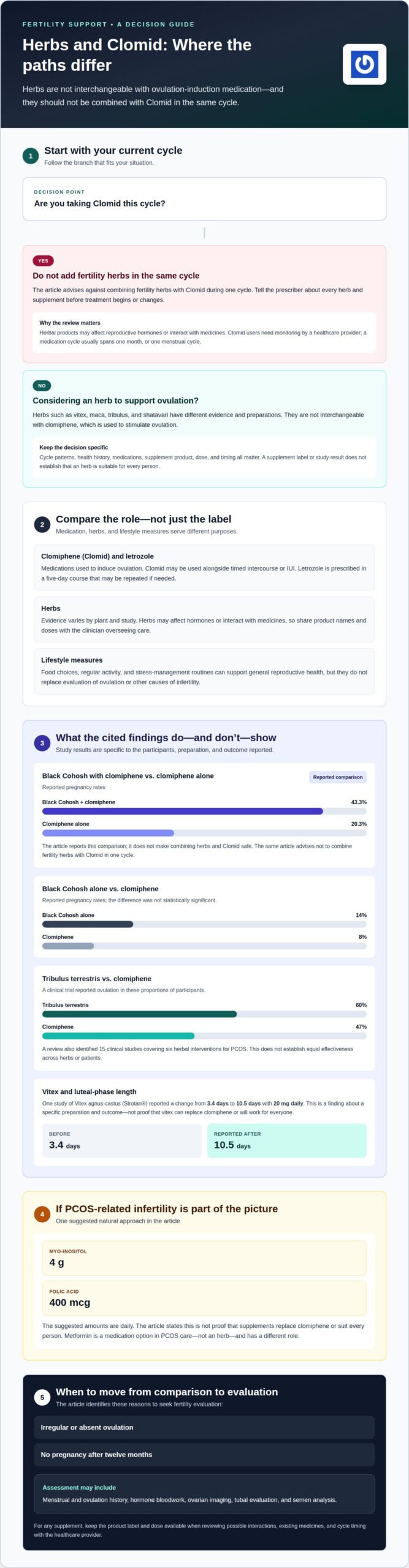
Don’t combine fertility herbs with Clomid during the same cycle. Clomid users need monitoring by a healthcare provider, and a medication cycle usually spans one month, or one menstrual cycle. Tell the prescriber about every herb and supplement before treatment begins or changes. This helps the care team consider possible interactions, existing medicines, and cycle timing.
Herbal products can affect reproductive hormones or interact with medicines. For example, tribulus may interact with medicines that affect blood pressure or blood sugar. Black cohosh requires particular caution: use it only under physician supervision, and avoid it with compromised liver function. Periodic bloodwork can help monitor hormone levels during supplement use. Keep product labels and doses handy for clinical discussions.
Before choosing fertility treatment, testing can help identify where to focus. Assessment may include menstrual and ovulation history, hormone bloodwork, ovarian imaging, tubal evaluation, and semen analysis. According to the Centers for Disease Control and Prevention, elevated serum FSH on cycle days 2, 3, or 4, or day 10 during a clomiphene challenge test, may indicate diminished ovarian reserve. Results help shape the next treatment discussion.
For PCOS-related infertility, a suggested natural approach pairs 4 g of myo-inositol with 400 mcg of folic acid daily. This recommendation is not proof that supplements replace clomiphene or suit every person. Metformin is a medication option that may be considered in PCOS care; it is distinct from herbs and has a different role. Discuss how it fits with other medicines and cycle monitoring.
Food, movement, and stress-management routines can support general reproductive health alongside clinical care. Build meals around vegetables, whole grains, protein, and unsaturated fats, and limit highly processed foods. Choose regular activity that suits your routine, such as walking or cycling, and try a calming practice like breathing exercises. These steps support overall health but don’t replace evaluation of ovulation or other causes of infertility.
Natural alternatives compared with clomiphene
Clomiphene and letrozole are medications used to induce ovulation; herbs and lifestyle changes serve different roles. Comparing their purposes and evidence can help you decide what to ask during fertility care.
Comparing Fertility Treatment Approaches
Clomid, the brand name for clomiphene citrate, stimulates ovulation and is commonly prescribed for infertility, particularly when ovulation is irregular. It may be used alongside timed intercourse or IUI. Letrozole is another medication option, prescribed in a five-day course that may be repeated if needed. Lifestyle changes can support reproductive health, but they aren’t equivalent to medication-based ovulation induction. Natural approaches also vary in evidence and how they work. Don’t assume herbs or lifestyle care can replace prescribed treatment.
Herbs Compared With Clomiphene and Metformin
Herbs, clomiphene, and metformin differ in purpose, evidence, and clinical use. A study of 100 women with PCOS compared Clomid with Black Cohosh; the groups received treatment for five and ten days, respectively. In another reported comparison, Black Cohosh combined with clomiphene was associated with a 43.3% pregnancy rate, versus 20.3% with clomiphene alone. Black Cohosh alone showed 14%, compared with 8% for clomiphene, a difference that wasn’t statistically significant. Metformin is a medication, not an herb, and its role in fertility care differs from both options.
Evidence and Risks of Herbal Alternatives
Evidence for herbal alternatives remains specific to each plant and study. A clinical trial reported ovulation in 60% of participants taking Tribulus terrestris, compared with 47% taking clomiphene. A review identified 15 clinical studies covering six herbal interventions for PCOS, but that doesn’t establish equal effectiveness across herbs or patients. Supplements can affect hormones and interact with medicines, so share product names and doses with your clinician. Seek fertility evaluation for irregular or absent ovulation, or after twelve months without pregnancy.
Clomiphene and letrozole are medication options; lifestyle measures may support general health, while herbal evidence varies. For supportive care alongside fertility treatment, explore integrative fertility support.
Vitex and menstrual cycle regularity
Vitex, also called chaste tree, is used in natural fertility discussions because cycle regularity and ovulation are closely linked. One study of Vitex agnus-castus, sold as Strotan®, reported luteal-phase length increasing from 3.4 days to 10.5 days with 20 mg daily. That finding concerns a specific preparation and measured outcome. It does not establish Vitex as a substitute for clomiphene or show that every person with infertility will respond similarly.
The luteal phase follows ovulation, so tracking cycle dates can help show whether its timing is changing. Record the first day of bleeding, cycle length, and any ovulation-test results before discussing vitex. Two randomized clinical trials reported improved pregnancy rates with Vitex agnus-castus among women with PCOS. Those findings are encouraging, but they don’t establish a universal dose or prove benefit for every PCOS pattern.
Maca Root is another herb identified as a possible natural alternative to Clomid. A commonly used daily amount is 1,500-3,000 mg, but that figure isn’t an individualized recommendation. Tribulus and shatavari are also discussed in herbal fertility settings; evidence and preparation can differ between products. Don’t treat a supplement’s “hormone balancing” label as proof of a specific estrogen receptor effect or improved ovulation.
If you’re considering vitex, maca, tribulus, or shatavari, review the exact product, dose, and cycle timing with a clinician. This matters especially before trying to conceive or when using fertility medication, because herbs can have unintended effects and interactions. Keep a cycle log and supplement list, then discuss irregular periods, absent ovulation, PCOS, and current medicines. That conversation can help distinguish cycle support from treatment of an underlying cause.
Clomid and medication alternatives
Clomid is used to help women conceive by stimulating ovulation, according to the United States Court of Appeals for the Tenth Circuit. Clinicians commonly prescribe clomiphene for irregular ovulation, including in some cases involving polycystic ovary syndrome (PCOS). Its effects aren’t limited to ovulation: hot flashes and mood changes are reported side effects, and treatment can increase the chance of multiple pregnancies. These tradeoffs make monitoring an important part of medication-based fertility care.
Letrozole is another medication used to induce ovulation, while metformin is used in some PCOS treatment plans. They aren’t interchangeable: the choice depends on the diagnosed cause of infertility, ovulation patterns, and relevant health history. Clomiphene acts through hormone signaling involving the pituitary, while metformin addresses metabolic factors associated with PCOS. A clinician considers these differences when discussing medication, timing, and follow-up.
Natural supplements are different again. Vitex, maca, and tribulus have been studied for reproductive effects, but findings for one herb or preparation don’t show that it can replace clomiphene. Lifestyle measures, such as balanced meals and regular activity, support general health; they don’t function as prescribed ovulation-induction medication. Tell your treating clinician about supplements before adding or changing them as part of a fertility plan.
A practical comparison starts with the treatment goal: inducing ovulation, addressing PCOS-related metabolic factors, or supporting general reproductive health. Bring cycle records, previous medication details, and a complete supplement list to the discussion. Ask how response will be assessed and what side effects or interactions deserve attention. For individualized support alongside medical care, explore functional medicine for fertility.
Clomid is commonly recommended as a first-line treatment for infertility, although 30% of women taking Clomid experience cervical mucus that is hostile to sperm.
A listed letrozole regimen is one tablet by mouth once daily for a 5-day course, which may be repeated if needed.
Ombright Wellness Fertility Acupuncture: Fertility Acupuncture
Ombright Wellness Fertility Acupuncture offers Fertility Acupuncture as supportive care alongside a fertility plan. It can complement conversations about cycle patterns, medication, and personal wellness, but it doesn’t replace prescribed ovulation-induction treatment or medical monitoring. The practitioner is an NCCAOM-Certified Diplomate of Acupuncture, offering a credentialed perspective on acupuncture care.
This supportive care may be worth discussing if you’re addressing infertility or managing a fertility-treatment cycle. Share your current medications and supplements with your healthcare team so complementary care fits alongside your existing plan. Ombright Wellness also offers Fertility IV Therapy, Fertility Ozone Therapy, and Fertility Hyperbaric Oxygen Therapy as supportive options.
To discuss Fertility Acupuncture as part of your care, contact Ombright Wellness Fertility Acupuncture.
Choose a Next Step That Fits Your Care
Before changing a fertility plan, write down what you want to address, such as cycle timing, medication concerns, or questions about supplements. This can turn an overwhelming decision into a focused conversation and help keep your priorities visible as care evolves.
For people considering natural alternatives to Clomid in Cutler Bay, the next step depends on the reason for treatment, health history, and current care plan. Integrative support can sit alongside fertility care, with options including Fertility Acupuncture, Fertility IV Therapy, and Fertility Ozone Therapy. Share your goals and existing treatment details so the discussion can center on what feels appropriate for you.
If you’re ready to discuss supportive fertility care, contact Ombright Wellness Fertility Acupuncture. You can take this one thoughtful step at a time.
Frequently Asked Questions
Are There Any Potential Risks With Natural Alternatives?
Potential risks include unwanted effects, an ingredient that conflicts with a health condition, or difficulty identifying which product caused a new symptom. If you’re considering natural alternatives to Clomid in Cutler Bay, keep the package and note when you started taking the product and any changes you notice. This record makes it easier to discuss the specific product rather than relying on memory.
What can I take instead of Clomid?
There isn’t one substitute that fits everyone. Depending on your goals and treatment history, options may include a different prescribed approach or non-drug support. Before changing course, note why Clomid was prescribed and what concerns you, such as side effects, cycle response, or a preference to avoid medication. This gives a fertility clinician a practical starting point for discussing options without relying on a supplement’s marketing claims.
What natural lifestyle changes may support ovulation and fertility?
Build routines around consistent sleep, avoiding tobacco, limiting alcohol, and attending recommended appointments. If you work night shifts or have a changing schedule, note that alongside your cycle dates; this context can help clarify cycle patterns during a discussion. These habits support general health, but they don’t explain why ovulation is irregular. Use them alongside fertility evaluation rather than as a substitute for investigating a concern.
What are the risks of taking fertility supplements with prescription medications?
Prescription medicines and supplements can have overlapping ingredients or effects, making total intake difficult to assess. Keep products in their original containers and record when you take each one. If a new symptom appears after you start or change a supplement, note when it began and contact the prescribing clinician before adjusting fertility medication. This record can help distinguish a possible product effect from a change in your cycle.