Age matters when planning a pregnancy, but it doesn’t tell the whole story or determine your next step on its own. If you’re preparing your body for pregnancy over 35 Coral Gables, it’s understandable to wonder which changes are worthwhile and whether supportive wellness care belongs alongside fertility evaluation.
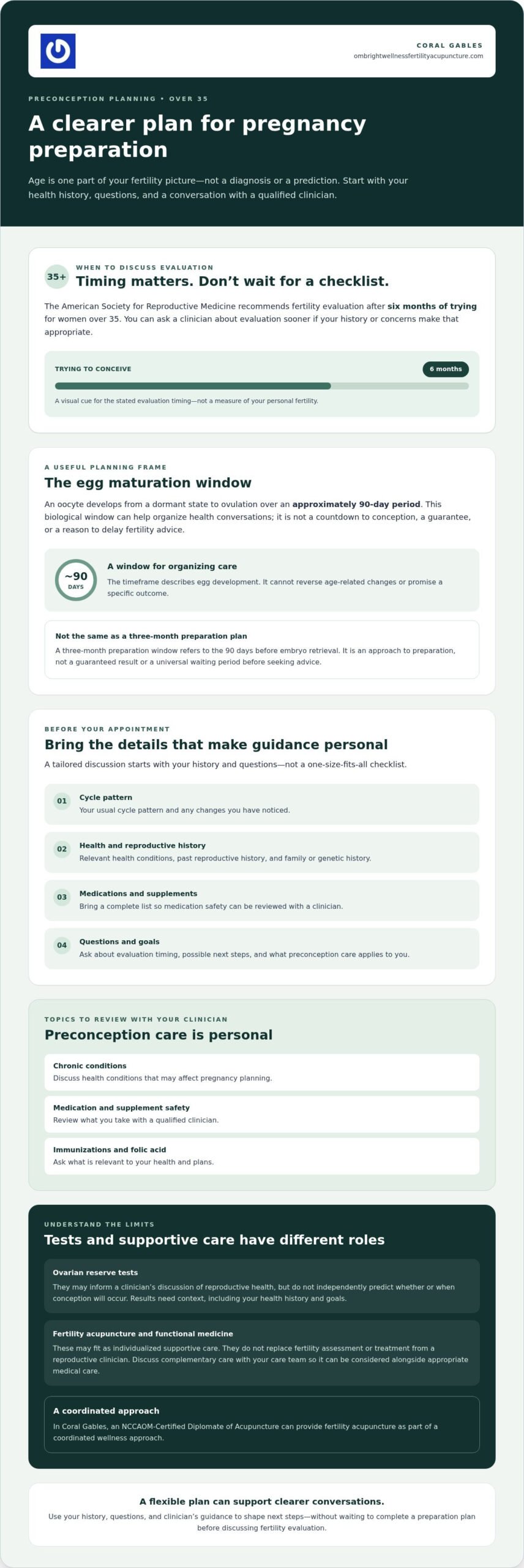
A practical plan starts with your personal health history, not a one-size-fits-all checklist. This guide covers preconception topics to discuss with your clinician, including medication safety, chronic conditions, immunizations, and folic acid. It also explains when age-related fertility evaluation may be appropriate. The American Society for Reproductive Medicine recommends evaluation after six months of trying for women over 35.
You’ll also learn how fertility acupuncture and functional medicine may fit as individualized supportive care, without replacing assessment or treatment from a reproductive clinician. In Coral Gables, an NCCAOM-Certified Diplomate of Acupuncture can provide fertility acupuncture as part of a coordinated wellness approach. The goal is to make conversations with your care team clearer and your next steps manageable.
Key Takeaways
- Age is one part of fertility planning. Bring your health history and questions to a clinician for guidance tailored to you.
- Learn what ovarian reserve tests can and can’t tell you, and how the egg maturation window fits into preconception planning.
- Use a flexible 90-day plan to organize cycle patterns, medications, and medical history, without delaying a fertility evaluation.
- When preparing your body for pregnancy over 35 Coral Gables, consider how individualized wellness support may complement, but not replace, fertility care.
- Ask Ombright about fertility acupuncture, functional medicine, diagnostics, and telehealth, including how these services may fit with your reproductive clinician’s plan.
Preparing for Pregnancy After 35 in Coral Gables: What to Understand First
Turning 35 doesn’t, by itself, define your fertility or determine whether you’ll become pregnant. Age is one part of an individual picture that may also include cycle patterns, medical history, and other reproductive factors. The term Advanced maternal age is used in discussions of pregnancy after 35, but it isn’t a personal diagnosis or a prediction of an individual outcome.
If you’re preparing your body for pregnancy over 35 Coral Gables, a useful starting point is a conversation with a qualified clinician. Preconception preparation means reviewing your health, making informed plans, and getting guidance suited to your circumstances. It isn’t a universal checklist, and it can’t guarantee a particular outcome. General health planning is also distinct from fertility diagnosis and medical treatment.
What does pregnancy preparation after 35 involve?
Preparation can include reviewing chronic health conditions, medications and supplements, immunizations, and family or genetic history with a clinician. They can help identify which topics need attention before pregnancy and which questions may call for a reproductive specialist. Your plan should reflect your health and preferences, rather than assuming the same steps apply to everyone.
Healthy habits can support overall well-being, but lifestyle changes or wellness therapies can’t reverse age-related changes in fertility. If you’re considering complementary care, discuss it with your reproductive clinician so it can be considered alongside, not instead of, appropriate evaluation or prescribed treatment.
When should I discuss fertility with a clinician?
You don’t need to finish a set preparation plan before asking about fertility. A timely conversation can clarify whether an evaluation is appropriate now and what information may help guide next steps. Age-related questions are best considered in the context of your personal history, rather than answered by age alone.
Cycle patterns and medical history may affect what a clinician recommends. Mention cycles that are irregular or have changed, prior reproductive concerns, significant health conditions, and medications you take. These details don’t establish a diagnosis on their own, but they can make the conversation more specific.
Before an appointment, consider writing down:
- Your usual cycle pattern and any changes you’ve noticed.
- Relevant health conditions, past reproductive history, and family history.
- All medications and supplements you take.
- Your questions about evaluation timing and possible next steps.
If you’re preparing your body for pregnancy over 35 Coral Gables, use this list as a starting point, not a test you must pass. Your clinician can help you decide what matters most for your situation and whether fertility evaluation should happen alongside preconception planning.
How Age, Egg Maturation, and Reproductive Health Shape Preparation
Fertility assessment is more useful when several pieces of context are considered together. Ovarian reserve tests may contribute to a clinician’s discussion of reproductive health, but they don’t independently predict whether or when conception will occur. Results need to be interpreted alongside your health history and goals. The ACOG guidelines for pregnancy over 35 offer a professional reference for age-related pregnancy care. Your reproductive clinician can help apply relevant guidance to your circumstances.
What is the egg maturation window?
The egg maturation window is the approximately 90-day period during which an oocyte develops from a dormant state to ovulation. It describes a biological process, not a countdown to conception or a promise that a particular intervention will change egg quality. Planning during this timeframe may help organize health discussions, but it can’t reverse age-related changes or guarantee an outcome.
This term is distinct from the three‑month preparation window, a 90-day period before embryo retrieval used to optimize egg quality, hormonal balance, and uterine receptivity. It describes a preparation approach, not a guaranteed outcome, and it isn’t a universal waiting period before seeking fertility advice.
Which assessments might a clinician discuss?
An individualized evaluation may include discussion of ovarian reserve, cycle history, and broader health context. A test result is one part of that conversation, not a standalone measure of your ability to conceive. Ask what a proposed test can clarify, what it cannot tell you, and whether other factors should shape your next steps.
Cycle timing and patterns can give a clinician useful context. Bring questions about changes you’ve noticed, relevant health conditions, and how age may relate to your personal situation. The appropriate assessment depends on the whole picture, so avoid treating any single test or timeline as a complete answer.
Hormones also have distinct roles. progesterone is essential for preparing the uterine lining for implantation and maintaining early pregnancy. Whether hormone assessment is relevant, and how to interpret it, are questions for a qualified clinician rather than conclusions to draw from symptoms alone.
For anyone preparing your body for pregnancy over 35 Coral Gables, the egg maturation window can be a helpful frame for discussion, not a reason to postpone evaluation. If you’re considering supportive care alongside reproductive-health guidance, you can learn about fertility acupuncture support and discuss whether it fits with your clinician’s plan.
Medical Fertility Care and Integrative Support: How Their Roles Differ
Medical fertility care and integrative wellness services can have different roles in a pregnancy plan. A reproductive clinician assesses fertility concerns, discusses diagnostic options, and guides medical decisions based on your history and findings. Supportive services, such as fertility acupuncture or functional medicine, may be considered as optional additions. They don’t diagnose infertility or replace fertility evaluation, prescribed treatment, or obstetric care.
What should medical fertility care address?
A reproductive clinician can review your personal and reproductive history, discuss which diagnostic options may be suitable, and explain how findings could affect your individual plan and timing. Ask what a proposed assessment is intended to clarify, what its limits are, and how the results may inform next steps. General wellness information can help you prepare for these conversations, but it can’t provide a diagnosis or an individualized medical recommendation.
For broader context, the Mayo Clinic’s guidance on preparing for a healthy pregnancy after 35 can help you identify topics to raise with your clinician. Your care plan should still be based on your health and clinical advice.
Where may fertility acupuncture fit?
Fertility acupuncture may be an optional supportive service for someone who wants to include a complementary approach in their care. It shouldn’t be presented as a way to guarantee conception or as a substitute for evaluation or treatment from a reproductive clinician. Ombright Wellness offers fertility acupuncture, with care provided by an NCCAOM-Certified Diplomate of Acupuncture. Read more about fertility acupuncture in Miami to understand the service in context.
Before adding acupuncture or another complementary therapy, discuss it with your reproductive clinician. Share the details with every member of your care team, including any supplements, herbal products, or wellness therapies you’re considering or already using. This helps clinicians consider your full plan and address questions about how different approaches fit together.
If you’re preparing your body for pregnancy over 35 Coral Gables, understanding the difference between evaluation and support can help you make informed choices without feeling you have to choose one instead of the other. For a broader overview of supportive approaches, see this guide to non-invasive fertility treatment. You can also ask about fertility acupuncture and integrative support as complementary care to discuss with your reproductive clinician.
A Practical Preconception Plan for Your Next 90 Days
A 90-day plan can make preconception conversations easier to organize, but you don’t have to complete one before seeking fertility evaluation. Treat it as a flexible discussion aid: gather useful information, note questions as they arise, and ask your clinician which steps fit your health needs. If you have concerns about fertility or timing, contact a qualified clinician rather than waiting for a planning period to end.
Before your first preconception or fertility appointment
A few notes can help you use an appointment well. Record what you know, and don’t worry about making the list perfect.
- Cycle observations: Note the timing and regularity of your cycles, along with changes you’ve noticed.
- Health history: Gather relevant diagnoses, past reproductive or pregnancy history, and family health information.
- Medications and supplements: List prescriptions, over-the-counter products, vitamins, and supplements, including how often you take them.
- Questions: Write down what you want to know about evaluation timing, possible next steps, and which clinician should guide each decision.
Review your health habits and supplements with a qualified clinician instead of making abrupt changes based on general advice. Ask which adjustments are appropriate for your medical history and whether any medication or supplement needs review before pregnancy. A clinician can help distinguish individualized guidance from steps that may not apply to you.
How should I use a three-month preparation window?
The three‑month preparation window is a 90-day period before embryo retrieval used to optimize egg quality, hormonal balance, and uterine receptivity. It’s specific to that context, not a universal prerequisite for natural conception, starting fertility care, or asking for an evaluation.
If embryo retrieval is part of your care, coordinate any preparation plan with the clinician overseeing that treatment. Ask what the timeframe means for your plan and which recommendations are specific to your care. If embryo retrieval isn’t part of your situation, don’t assume you need to wait three months before discussing your options.
For anyone preparing your body for pregnancy over 35 Coral Gables, the most useful plan is one you can review and adapt with your care team. If you’d like to explore individualized supportive services alongside your reproductive clinician’s guidance, discuss fertility support options with Ombright Wellness.
Considering Fertility Support in Coral Gables: What to Ask Ombright
Fertility care can involve different professionals and services, each with a distinct role. Ombright Wellness offers fertility acupuncture, functional medicine for fertility, fertility-related diagnostic lab services, and telehealth consultations as supportive care. These services may be considered alongside guidance from a reproductive clinician, not as a replacement for fertility evaluation or prescribed treatment.
The practice does not provide surgical IVF or obstetric medical care. Its acupuncture care is provided by an NCCAOM-Certified Diplomate of Acupuncture, a credential you can consider as you learn about a provider’s training and approach. If you’re preparing your body for pregnancy over 35 Coral Gables, ask how any supportive service may fit with your current care plan before deciding whether it’s right for you.
Questions to ask before choosing supportive fertility care
Clear questions can help you understand what a service involves and whether it aligns with your goals. Consider asking:
- How might this service fit alongside my reproductive clinician’s evaluation or treatment plan?
- What evidence supports this specific therapy, and what are its limitations?
- Are there considerations related to my health history, medications, or other treatments?
- Would an in-person visit or telehealth consultation suit my needs, and what should I confirm about availability?
Share information about supplements and complementary therapies with your reproductive clinician and other members of your care team. This helps them consider your full plan and discuss potential concerns. Ask the provider to explain what the service can and can’t address. No supportive approach should be treated as a promise of conception or a substitute for medical assessment.
How can a Coral Gables consultation support your next step?
A consultation can give you a chance to describe your goals, learn which services are offered, and ask how supportive care may coordinate with your reproductive clinician’s recommendations. It can help clarify options, but it can’t establish a diagnosis or determine in advance that a particular therapy is suitable. Confirm whether an in-person visit or telehealth consultation is appropriate for your needs and location.
Ombright Wellness offers in-person visits and telehealth consultations for people seeking fertility support in Coral Gable, Kendall, Cutler Bay, Homestead, Pincrest, Miami, Coconut Grove, South Beach, Brickel, and Key West. For a direct conversation about supportive fertility care, Contact Ombright Wellness to discuss supportive fertility care.
Take Your Next Step With a Clear, Individual Plan
Preparing for pregnancy after 35 is best approached as coordinated planning, not a test of whether you’ve done everything “right.” Age is one part of your health picture, and timely guidance from a reproductive clinician can help you understand which evaluation or next steps make sense for you. A practical preconception plan can organize your questions without requiring you to delay care.
When preparing your body for pregnancy over 35 Coral Gables, remember that supportive wellness services may complement fertility care, but they don’t replace medical evaluation or prescribed treatment. Ombright Wellness offers fertility acupuncture with an NCCAOM-Certified Diplomate of Acupuncture, along with in-person visits and telehealth consultations. Ask how a service may fit your goals and your reproductive clinician’s plan.
To discuss supportive fertility care with Ombright Wellness, contact the clinic. Start with one informed conversation and care guided by your needs.
Frequently Asked Questions
Is 35 too late to prepare for pregnancy?
No, 35 is not too late to prepare for pregnancy, and age alone can’t determine an individual’s chance of conceiving. If you’re preparing your body for pregnancy over 35 Coral Gables, start with a conversation about your health history, cycle patterns, and goals. A clinician can help you understand which steps are relevant to you. Preparation can support informed planning, but it can’t reverse age-related changes or guarantee pregnancy.
How long should I prepare my body before trying to conceive after 35?
There’s no single preparation period that’s right for everyone, and you don’t need to wait a set number of months before asking about fertility. A three‑month preparation window refers to the period before embryo retrieval, not a universal prerequisite for natural conception. Discuss your plans with a qualified clinician, especially if you have questions about timing or fertility evaluation, so preparation doesn’t inadvertently delay care you may need.
What fertility tests should I ask my doctor about after 35?
Ask which assessments, if any, make sense based on your health and reproductive history. A clinician may discuss ovarian reserve assessment alongside cycle patterns and other health factors. Ovarian reserve results can inform a conversation, but they don’t independently predict whether you’ll conceive. Ask what a proposed test can clarify, what its limits are, and how the result could affect your next steps.
Can lifestyle changes improve fertility after 35?
Health habits can support overall well-being before pregnancy, but they can’t guarantee conception or reverse age-related fertility changes. Ask your clinician which steps fit your health needs, including reviewing medications and supplements, managing ongoing conditions, and discussing nutrition or activity. Recommendations should reflect your circumstances rather than a generic checklist. Avoid starting or stopping medication or supplements solely on general advice; review changes with a qualified clinician.
Can fertility acupuncture support pregnancy preparation after 35?
Fertility acupuncture may be considered as supportive care, but it shouldn’t replace fertility evaluation or prescribed treatment, and no pregnancy outcome is guaranteed. Discuss the specific therapy, its evidence and limitations, and your health history with your reproductive clinician before adding it. Ombright Wellness offers fertility acupuncture with an NCCAOM-Certified Diplomate of Acupuncture. Local readers can ask whether an in-person visit or telehealth consultation fits their needs.
Should I see a fertility specialist before trying to conceive?
Not everyone needs to see a fertility specialist before trying, but a preconception discussion with a clinician can help you decide what’s appropriate for your circumstances. The American Society for Reproductive Medicine recommends fertility evaluation for women over 35 after six months of trying without success. Personal history or cycle concerns may affect your next steps, so ask a clinician whether an earlier evaluation is suitable for you.
Can I use integrative fertility care alongside IVF treatment?
Integrative services may be considered alongside IVF, but coordinate them with your reproductive clinician and share details about therapies and supplements with your care team. Ombright Wellness offers supportive services for people on IVF journeys, but does not provide surgical IVF procedures or obstetric medical care. Ask whether a specific service fits your treatment plan, what its limits are, and how it can be coordinated with your IVF care.